
Strategic Framework for M&A
A strategic framework turns the company's strategy into a few acquisition mandates. Each mandate names a problem M&A is allowed to solve, the executive who owns it, the money and people set aside, and the evidence that would end the search. Its main job is to cut the stream of attractive-looking deals down to the few that change what the company can do. Market maps and theme lists earn their place only when they change where capital and management time go.
CorpDev translates corporate and business-unit priorities into those mandates, with fair alternatives, evidence requirements, and a price limit for each. The M&A strategy guide covers how to write the thesis behind a mandate. This guide covers the framework around it: how mandates are set, compared, priced, tested, and stopped.
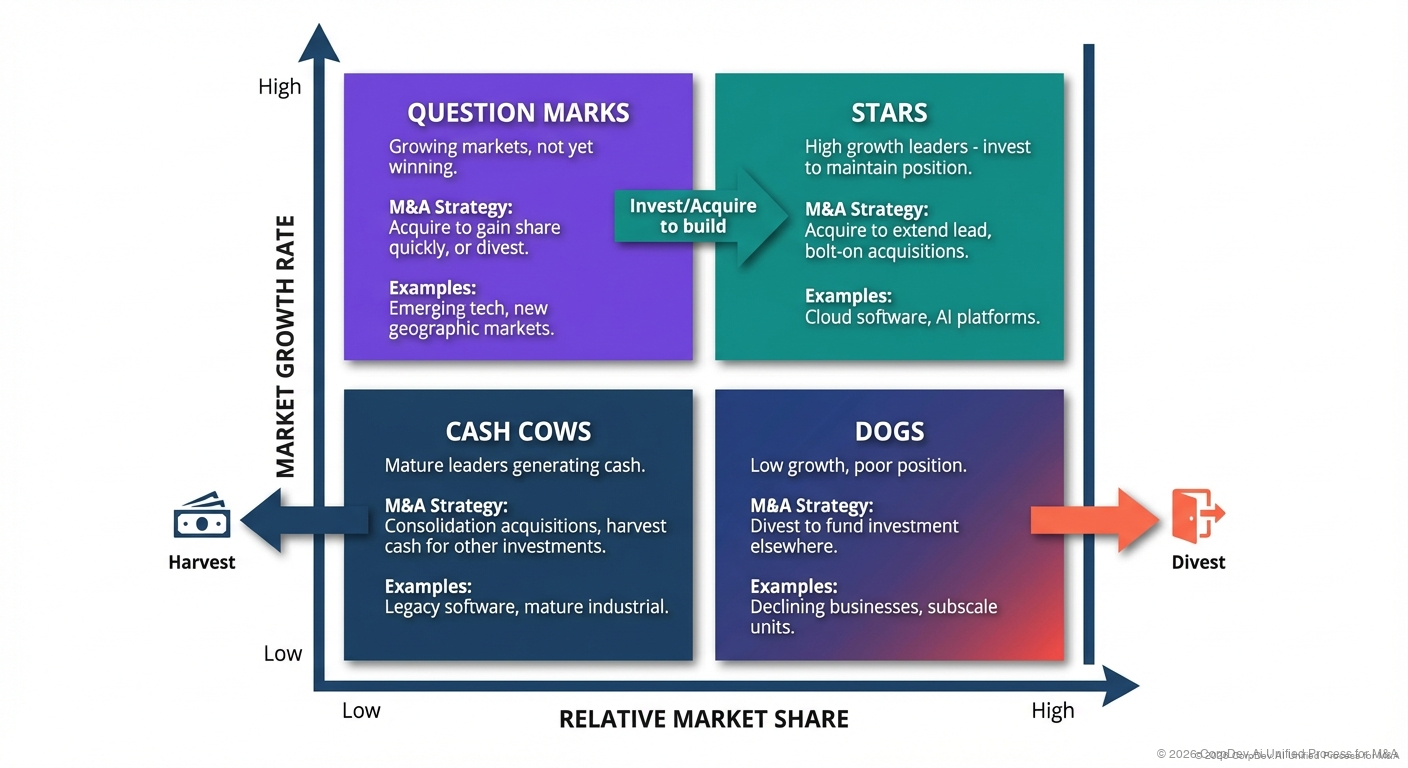 Stars: extend advantage through capability acquisition ↗Question marks: compare build, buy, partner, and wait ↗Cash cows: manage the portfolio of commitments ↗Dogs: evaluate divestitures and retained-business economics ↗Divest or exit ↗
Start with the outcome, then write a one-page mandate
Name the result the business needs. It might be a product gap to close, a new customer workflow, a region to enter, or a scarce capability to secure. It might also be better service coverage or a reshaped portfolio. Say who the customer is, how the result makes money, when it matters, and which executive will run it. "Participate in AI" or "become a platform" names no customer and no decision.
Then work back to the capability gap. Sort what is needed into four groups: what the company already has, what it can realistically build, what a partner can supply, and what it would have to own. Separate the essential from the nice-to-have. The list of target companies should follow from this logic, rather than being assembled after a banker brings in a company.
Each mandate fits on one page. A blank field in the table below means the mandate is not ready for approval.
| Field | What it must say |
|---|---|
| Business outcome | The customer or operating result, and the date by which it matters |
| Capability gap | The specific technology, people, assets, rights, or distribution needed |
| Why own it? | What control provides that a partnership or commercial contract cannot |
| Target boundary | Relevant products, customers, geographies, size, and exclusions |
| Source of value | The additional cash flows, and what has to happen to earn them |
| Resources set aside | Capital, leadership time, specialist capacity, and integration budget |
| Sponsor | The executive who accepts the operating commitment |
| Evidence and stop rule | The facts needed to proceed, and the findings that end the mandate |
Compare build, buy, partner, and wait fairly
Compare every route against the same customer outcome over the same period. For each one, estimate the investment, the time until the capability is usable, the chance it is delivered, the operating economics, and the control it gives. Then add two points teams often skip: how easily the choice can be reversed, and what obligations it creates later.
A common mistake is to compare buying a fully commercial business with building only a prototype of its technology. The table lists what a full cost includes for each route.
| Route | What the full cost includes |
|---|---|
| Build | Recruiting, development, failed attempts, launch, winning customers, support, and the opportunity cost of the people involved |
| Buy | Purchase price, integration, retention, customer migration, investment the target still needs on its own, and the risk that the deal goes wrong |
| Partner | Commercial terms, integration, governance, dependence on the partner, and exposure if the partner ends the contract or changes owner |
| Wait | A real cost only where a credible comparison shows what waiting loses; waiting also keeps capital free and lets the company learn more first |
Ask a different function to challenge each route. Product and engineering test whether building is feasible. Procurement or alliances test the partner options. Finance puts every route on the same cash-flow basis. The business sponsor judges delivery and relevance to customers. CorpDev should never build the acquisition case and quietly assume the alternatives fail. The M&A strategy guide lists the questions each function answers.
Separate a good company from a good acquisition
A strong business can still be a poor acquisition for you. Assess two things separately: how durable the target is on its own, and what your company specifically adds. Name that advantage: customer access, shared infrastructure, manufacturing capability, geographic presence, or complementary intellectual property.
Each claimed advantage needs an owner and a clear account of how it produces cash. The claims below sound alike in a pitch, but each rests on different facts.
| Claimed advantage | What must be true |
|---|---|
| Cross-selling | Enough eligible accounts, and a sales approach that can sell both products |
| Faster product development | Compatible technical architecture, and people free to do the work |
| Procurement savings | Spending that actually overlaps, and specifications suppliers can meet |
A higher public-company valuation multiple does not belong on this list. It is a market price, not an advantage in running the business.
Use scorecards to organize evidence, not to approve deals. A strong score on unrelated points should never offset a fatal problem. Mark the true deal-breakers separately:
- An unacceptable liability
- Missing rights the business depends on
- No operating sponsor
- An integration the company cannot carry out
- A price above the approved economic case
Build a value bridge the board can challenge
A value bridge walks from what the target is worth on its own to the most you can pay. Show each step separately:
- Standalone value
- The benefits only your company can create
- The costs of achieving them
- Dis-synergies: value lost by combining, such as customers who leave
- The uncertainty that remains
From the bridge, set the maximum price consistent with the company's return and downside requirements. The negotiating target sits below that ceiling. It should never be worked backward from the seller's asking price.
Three rules stop the same improvement being counted twice:
- If cross-selling is already in the cash-flow forecast, it cannot also justify an unexplained "platform premium."
- If the target would achieve a saving on its own, count only the extra part your company adds.
- If the benefits depend on later acquisitions, include the cost and uncertainty of those deals.
Finally, record the few assumptions that move value most and the evidence that would settle each. That list points diligence at the decision, so the team avoids a thorough report that never connects to the price.
Example: buying was not the fastest route
This example is fictional. An industrial company needs remote diagnostics for its installed equipment within two years. Its engineers can build the core software but lack data connectors, experience deploying at customer sites, and field support. An acquisition target has all three. A third-party partner offers a licensed solution.
The acquisition pitch rests on speed. Costing all three routes against the same customer outcome changes the picture:
| Route | What the comparison showed |
|---|---|
| Buy the target | Brings the missing connectors, deployment experience, and field support, but still needs substantial product work to run on the buyer's older equipment |
| License from the partner | Can launch a narrower service earlier |
| Build internally | May give stronger long-term control |
The committee weighs three fully costed paths. It may still choose to buy, but only if the acquired team and evidence from installed customers justify the purchase and integration cost. A staged partnership can also make sense if it tests customer adoption before the company commits capital to ownership. The decision turns on the actual capability gap, not on what the transaction is called. The M&A strategy guide follows a similar case from the thesis side.
Weigh each deal against existing commitments
Review a proposed deal alongside current integrations, capital projects, product launches, and leadership vacancies. The money to finance a deal does not bring the people to carry it out. Name the scarce resources by person or function, such as integration leaders, IT architects, regulatory specialists, plant engineers, or business-unit managers.
Then look for shared exposure. Acquisitions in different product categories can still depend on the same customer budget, technology provider, commodity, or sales channel. Stress-test the combined business, including the cost of propping up a struggling acquisition during a downturn in the core.
Sequence deals on purpose. An enabling acquisition may need to settle before add-on deals can create value. A proposed "platform" with no credible add-on targets or integration method should get no credit for an acquisition program that exists only on paper.
Test every theme against three futures
Shared exposure is hard to see because themes are usually tested one at a time, against the plan's base case. Three themes in different product lines can all quietly assume that customers keep spending, the current technology keeps winning, and capital stays cheap. If one of those assumptions fails, several mandates fail together.
Define several futures that challenge the plan in different ways. Apply each one consistently across all acquisition themes. Record which assumptions fail together and what leadership would change.
A hypothetical example:
| Theme | Demand falls | Technology shift | Capital squeeze |
|---|---|---|---|
| Buy regional field-service firms | Holds: "revenue is contracted service, not new equipment sales" | Holds: "installed machines still need on-site technicians" | Fails: "six acquisitions, funded with acquisition debt" |
| Add diagnostics software to the installed base | Stronger: "customers defer replacement and extend service" | Fails: "we would be first to offer diagnostics on this class of machine" | Holds: "one bolt-on under $30m" |
| Enter the aftermarket in a new region | Fails: "aftermarket demand follows the new-equipment base we are building" | Holds: "parts demand is technology-neutral" | Fails: "a platform acquisition is needed for scale" |
Themes that hold in every future deserve standing mandates and steady sourcing effort. A theme that works in only one future is a bet. Keep it if you like the odds, but name the signals that show that future arriving and hold back capital until they appear. The shared assumption belongs in front of the board, because it is the portfolio's real exposure.
The check that matters: every verdict must quote a line from your theme documents. A verdict based on general sector commentary tests nothing about your themes. Resist turning the grid into a weighted score, because the reasons matter more than the total.
Hold decision gates, and log every exception
Each gate answers a different question, so a later gate cannot make up for a skipped one.
| Gate | What is approved |
|---|---|
| Mandate approval | The strategic need, sponsor, alternatives, and resources set aside |
| Target approval | Fit, and the evidence needed to justify exclusive negotiations |
| Before signing | Price, downside case, commitments, and integration owner |
| After closing | A review of the original thesis against operating results, with actions revised as assumptions change |
Keep a decision log. Record the alternatives rejected and why, the assumptions, any dissent, and the conditions attached to approval. The log matters most when a sponsor changes or an auction turns competitive. A request to exceed the approved price must cite new evidence or an explicit change in risk appetite. Calling the asset "unique" is not enough.
Review the framework when the evidence changes. Customer priorities may shift, a build effort may succeed, or a partner may become available. Financing may tighten, or integration capacity may run out. Stop mandates that no longer solve the business problem. Commitments avoided belong in CorpDev's record alongside deals closed.
Where to go next
Start upstream with Corporate Strategy: Roger Martin, BCG, and McKinsey.
Continue with M&A strategy, competitive M&A playbooks, and approval gates.
© 2026 CorpDev.Ai Unified Process for M&A