
What is Corporate Development?
Corporate development is the team that turns company strategy into decisions to buy, sell, partner with, or invest in other businesses. Its job is to put capital where it strengthens the company's competitive position. Closing deals is one way to do that job, and walking away from a deal can be the best result.
At a large company, the hard part is connecting three groups that often work apart: strategy, investment approval, and the businesses that must deliver the results. A strong CorpDev team keeps them connected from the first market idea to the review of the deal years after closing.
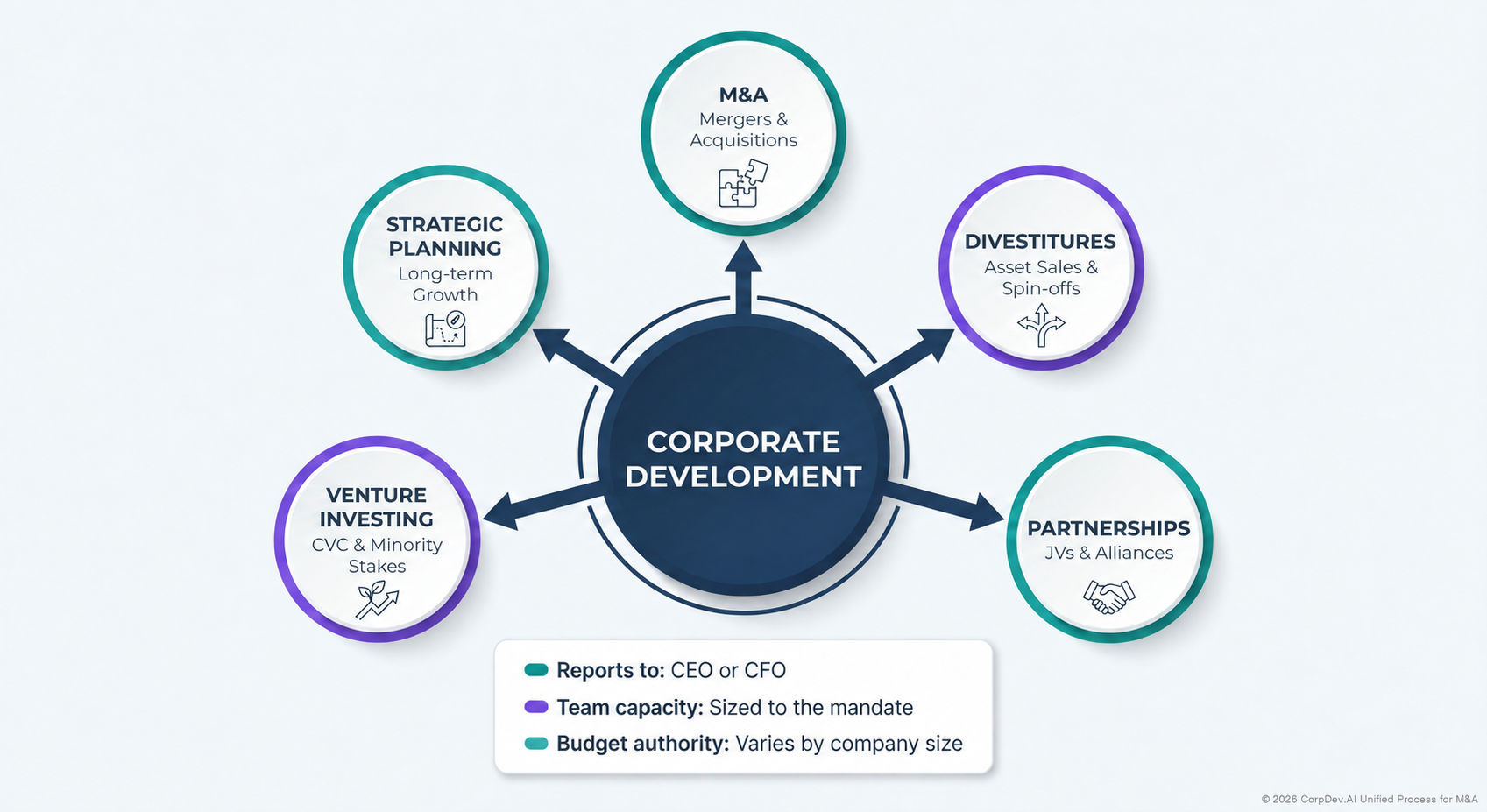 M&A: Mergers & acquisitions ↗Divestitures: Asset sales & spin-offs ↗Partnerships: Joint ventures & alliances ↗Venture investing: CVC & minority stakes ↗Strategic planning: Long-term growth ↗Build a corporate development function ↗Reporting line and access ↗Size the team against concurrent demand ↗Define the function mandate and authority ↗
Text links for this illustration
- M&A: Mergers & acquisitions
- Divestitures: Asset sales & spin-offs
- Partnerships: Joint ventures & alliances
- Venture investing: CVC & minority stakes
- Strategic planning: Long-term growth
- Build a corporate development function
- Reporting line and access
- Size the team against concurrent demand
- Define the function mandate and authority
Write the mandate before you build the team
Start with a charter: a short document, approved by leadership, that says what the function covers and who decides what. "Own M&A" is too vague. It leaves open who chooses markets, who sponsors a deal, who sets the price, who approves concessions, and who runs integration.
The charter must settle six questions. Any left open will be answered later, under deal pressure.
| Charter question | What leadership must settle |
|---|---|
| Scope | Which company priorities and businesses CorpDev serves; whether minority investments, partnerships, and divestitures are included |
| Decision rights | Who can authorize outreach, adviser spend, an indicative offer, exclusivity, signing, and closing |
| Business accountability | Which executive accepts the operating plan, and where the acquired business's results will be reported |
| Financial rules | Who sets return requirements, liquidity limits, valuation conventions, and how much downside is tolerable |
| Who does the work | What stays central, what business units run, and which specialist functions must take part |
| After closing | Who runs integration, confirms the value was captured, and leads the post-deal investment review |
The charter should also say how unsolicited opportunities enter the process. A target introduced by the CEO, or one that arrives with a banker's deadline, faces the same strategic and financial questions as a target the team found itself.
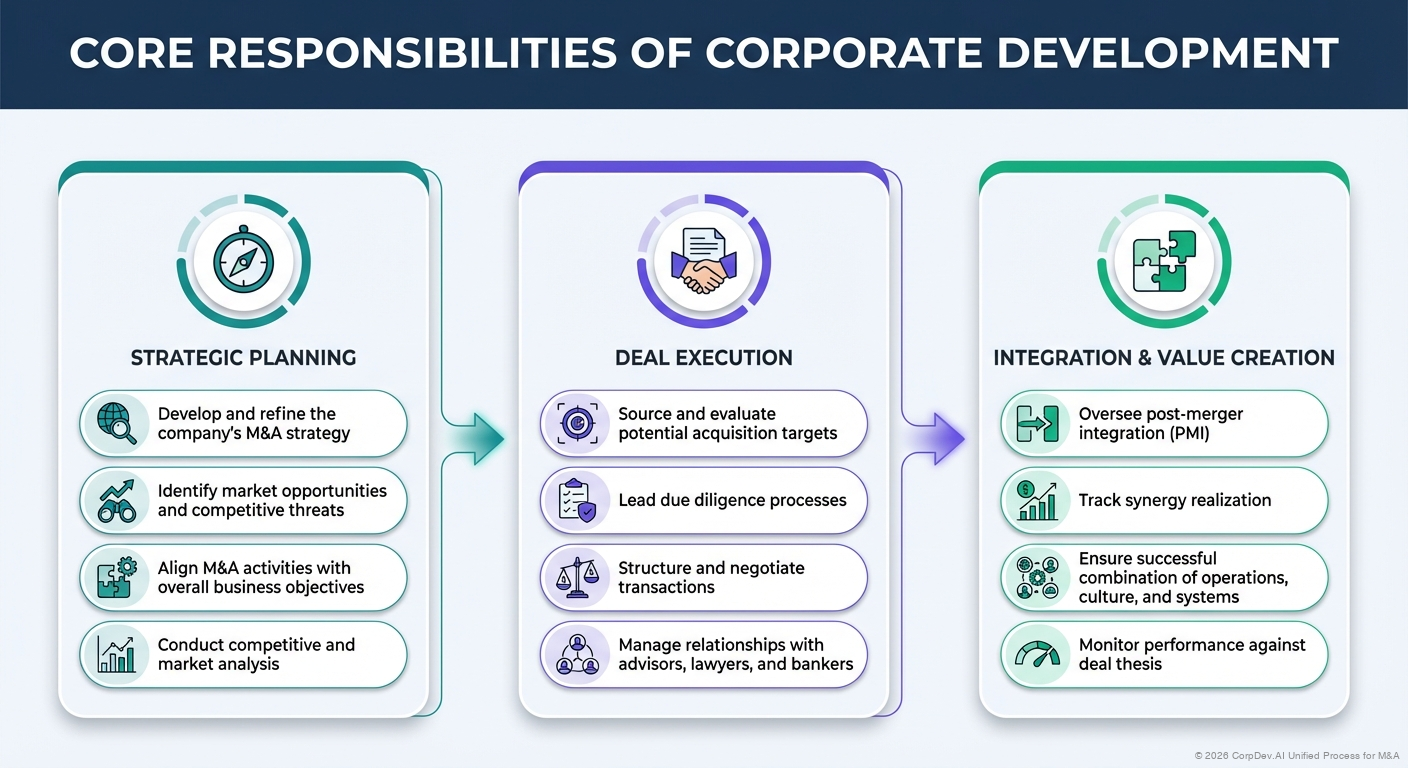 Strategic planning ↗Develop the M&A strategy ↗Identify opportunities and threats ↗Align transactions with business objectives ↗Analyze markets and competitors ↗Deal execution ↗Source acquisition targets ↗Lead due diligence ↗Structure and negotiate transactions ↗Manage advisers and workstreams ↗Integration and value creation ↗Oversee post-merger integration ↗Track synergy realization ↗Combine operations, culture and systems ↗Monitor performance against the deal thesis ↗
Text links for this illustration
- Strategic planning
- Develop the M&A strategy
- Identify opportunities and threats
- Align transactions with business objectives
- Analyze markets and competitors
- Deal execution
- Source acquisition targets
- Lead due diligence
- Structure and negotiate transactions
- Manage advisers and workstreams
- Integration and value creation
- Oversee post-merger integration
- Track synergy realization
- Combine operations, culture and systems
- Monitor performance against the deal thesis
Judge the function by five outputs
Together, these outputs cover a deal's life, from choosing where to look to confirming that the value arrived.
1. A clear view of where buying beats the alternatives
Turn corporate strategy into specific gaps: a missing product capability, a route to market, a scarce asset, or a business that would do better with a different owner. For each gap, compare buying with building internally, partnering, licensing, and doing nothing. CorpDev should make the alternatives strong enough that the acquisition case has to beat something real.
The deliverable is a set of investment theses. Each has evidence, exclusions, an executive sponsor, and a clear reason why this company in particular can create value from the deal. A list of attractive sectors is only the starting point.
2. A market map kept current
Know the relevant companies before they come up for sale. For each one, record who owns it, its capabilities, customer overlap, likely integration demands, and your history of contact with it. Mark what is verified, what is estimated, and what is unknown.
Record the companies that do not fit, and why. Otherwise the team repeats rejected work each time a new executive or adviser raises the same name.
3. An investment case leadership can decide on
Bring six things into one case: the strategic rationale, the target's standalone economics, the value only you can create, the price, the cost of delivering the plan, and the downside. The case must answer one question: what value is left for the buyer after paying the seller and funding the work? A large synergy estimate alone does not answer it.
Finance checks the model and ties it to the company's operating plan. The business sponsor accepts the assumptions that depend on customer behavior, product delivery, and operating change. CorpDev makes sure the recommendation holds together as a whole, and presents the evidence against it at full strength.
4. A deal carried through to closing
CorpDev coordinates diligence, valuation, negotiation, documents, financing, and the path to closing, but each judgment stays with its owner. Counsel gives legal advice, specialists own conclusions in their fields, and the authorized investment body accepts the remaining risk. A combined CorpDev presentation does not move those responsibilities.
Keep a decision record. It shows what was approved, the assumptions behind the approval, the open conditions, and which changes need a new decision. Without it, "we approved the deal" becomes permission for any later concession on price or risk.
5. A handover the receiving business accepts
Before signing, name the executive who will deliver the value case and the integration leader who will run the transition. Link each significant diligence finding to the response: a revised forecast, a contract protection, funded remediation, a risk knowingly accepted, or a reason to stop.
At closing, hand over more than a data room:
- The approved baseline and the seller's commitments
- Operating dependencies and retained risks
- Contract deadlines
- The reasoning behind the big choices
Keep CorpDev involved in post-deal reviews, so that what the company learns improves the next investment case.
Agree where CorpDev's job ends and others' begin
Several functions own part of every deal. The table shows what each contributes and the working rule that keeps gaps and overlaps out.
| Function | What it contributes | Working rule with CorpDev |
|---|---|---|
| Corporate strategy | Company priorities and competitive choices | Test together which gaps call for an acquisition; refresh theses when strategy changes |
| Business development | Commercial partnerships and customer or channel relationships | Decide together when a commercial relationship becomes a case for acquiring or investing |
| Finance and treasury | Economics, funding, liquidity, accounting, and measurement | Check assumptions independently; reconcile deal forecasts to the company plan |
| Legal and compliance | Legal structure, obligations, risk advice, and documents | Bring counsel into process design before any external commitment |
| Business units | Customer knowledge, operating capabilities, and ownership of results | Require a named sponsor who explicitly accepts the delivery commitments |
| Integration leadership | Transition design and cross-functional delivery | Test feasibility during diligence; carry decisions into operations |
Choose the reporting line that fits the mandate and gives access to decisions. A senior reporting line grants no investment authority, and it never replaces a business sponsor.
Draft the charter from eight prompts
Answer these prompts in a page or two, then take the draft to leadership for approval.
- Purpose: Which company outcomes does the function exist to improve?
- Coverage: Which deal types, businesses, and markets are in scope, and which are explicitly out?
- Authority: Which bodies approve what, which decisions are delegated, and when does each delegation expire?
- Accountability: Who owns strategic fit, the economics, legal advice, integration, and actual results?
- Resources: What internal capacity is committed, and what are the rules for calling on specialists?
- Information: Who controls access, who owns the records, and where is the official record of decisions kept?
- Measures: Which few indicators link market coverage, decision quality, execution, and investment results?
- Review: Which events reopen the charter, such as a leadership change, a portfolio shift, or a shortage of integration capacity?
Spot an unhealthy mandate early
A CorpDev function goes wrong in three recognizable ways:
- Service desk: business units hand over targets but decline to own the results.
- Advocacy group: every market fact it presents supports buying something.
- Bottleneck: it claims decisions that belong to accountable specialists.
Fix each with explicit decision rights and evidence requirements. Another layer of meetings fixes none of them.
Review the function with four questions. Which strategic choices are now clearer? Which investments were improved or avoided? What value is still to be delivered, and by whom? Where has the company run out of capacity? These questions hold the function to account for better decisions rather than for deal volume.
Continue with M&A strategy development, building the CorpDev function, and CorpDev metrics.
© 2026 CorpDev.Ai Unified Process for M&A