
Investment Committee Presentations
An investment committee presentation helps the committee make an informed capital decision under uncertainty. It sets out the strongest case for the deal, the strongest case against it, and the terms on which management recommends going ahead. When a persuasive deck hides contradictions, the investment process has failed.
Each part of the pack has an owner:
- The CorpDev deal lead owns the pack as a whole.
- The business sponsor owns the operating recommendation.
- Finance signs off the economics and the consistency of the model.
- Functional leads own their diligence conclusions.
- Legal confirms what authority is required and reviews proposed commitments.
The committee's actual mandate determines what it can approve.
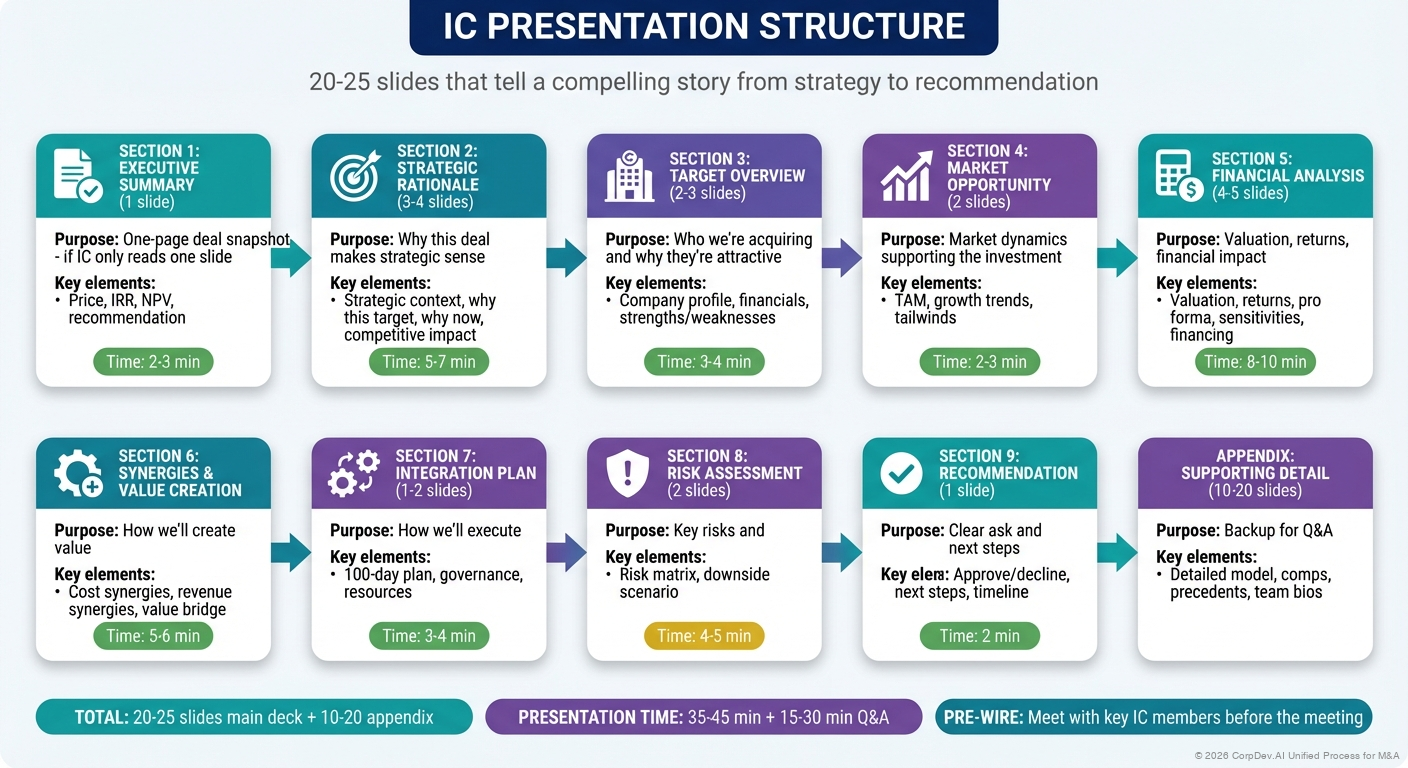 Executive summary ↗Strategic rationale ↗Target overview ↗Market opportunity ↗Financial analysis ↗Synergies and value creation ↗Integration plan ↗Risk assessment ↗Recommendation ↗Supporting detail ↗Illustrative pack structure ↗Run the committee meeting ↗Prepare stakeholder challenge ↗
Illustrative presentation sequence. Tailor the length and meeting time to the decision, material risks and committee requirements.
Start with the decision sentence
Write the request before building any slides:
Authorize [specific action] for [target or perimeter], within [price, structure, funding, and resource limits], subject to [conditions], with authority expiring or returning for review when [triggers].
Be precise about the step being authorized. Permission to investigate, to submit an indicative offer, to enter exclusivity, to negotiate final terms, to sign, and to close are separate decisions. A committee may recommend an investment while another body holds the authority to carry it out. Say so explicitly.
Give the latest date by which a decision is still useful, and what delay would cost. Describe seller deadlines factually. A deadline creates urgency; it does not make the evidence sufficient.
Order the pack to follow the investment logic
The twelve sections below are a practical starting point. Each answers one question with one essential exhibit. Combine sections for a simple deal and expand them when complexity earns it; the slide count follows the decision, not a template.
| Section | Question it must answer | Essential exhibit |
|---|---|---|
| 1. Decision and recommendation | What exactly are we being asked to authorize? | Request, limits, conditions, strongest objection |
| 2. Strategic objective | What business problem are we solving? | Evidence of the gap and the outcome sought |
| 3. Alternatives and target selection | Why buy this company rather than take another route? | Build/buy/partner/wait comparison |
| 4. Target and perimeter | What exactly are we buying? | Business model, ownership, assets, exclusions, dependencies |
| 5. Standalone business quality | Which earnings and cash flows will last? | Historical bridge, operating drivers, forecast |
| 6. Diligence conclusions | What did the evidence confirm or refute? | Thesis claims, findings, limits, resolution |
| 7. Valuation and economics | What value exists, and how much do we keep? | Valuation range, value-to-buyer bridge, returns |
| 8. Funding and effects on the company | Can we fund and absorb the investment? | Sources and uses, liquidity, credit, reporting effects |
| 9. Value creation and integration | Who will deliver the plan, and with what resources? | Initiative owners, costs, dependencies, operating model |
| 10. Downside and terms | What can go wrong, and how is the exposure handled? | A realistic combined downside, protections, remaining risks |
| 11. Changes and open decisions | What differs from the last approval? | Bridge of changes in price, forecast, terms, and risk |
| 12. Final request | What should the committee decide now? | Proposed decision record and next review |
Keep the recommendation visible throughout. A meeting that spends its first half on the target's marketing story, while the investment choice stays unclear, has wasted its best time.
Make the first page stand on its own
A director should understand the proposed commitment from page one, without opening the model. The page needs the target and perimeter, the strategic purpose, the economics on a stated basis, the execution owner, the biggest uncertainty, and the recommendation. The template shows one way to fit them.
INVESTMENT DECISION: target / date / version
Action requested / authority required:
Management recommendation:
Strategic outcome and why buying is preferred:
Enterprise value / equity consideration / total funding:
Standalone value / benefits only we create / costs / value to us:
Base and downside economics, with key assumptions:
Business sponsor / integration owner / resources committed:
Three critical findings or uncertainties:
Strongest objection and our response:
Conditions, negotiating limits, expiry, and return triggers:
Use placeholders only while drafting. In the circulated pack, label any unresolved input as an open question and state what it means for the decision.
Make the strategic case an argument backed by evidence
Show the customer or operating evidence behind the objective. Explain why the company needs to own the target, why the target is distinctive, and what your company adds. Compare alternatives on the same outcome, time horizon, and resources.
Leave out market-share diagrams nobody can source, invented industry statistics, and large addressable-market figures unrelated to how many customers you can actually win. If a market estimate matters, disclose its definition, date, source, and how it relates to the share you can realistically capture.
On the target, focus on what affects the investment: revenue model, concentration, recurring demand, assets, critical people, rights, capital needs, and dependencies. Move facts that do not change the decision to the appendix.
Show how diligence changed the recommendation
Replace the list of workstreams marked "complete" with a short findings table. Each row links an assumption in the case to what diligence found and what changed as a result.
| Investment assumption | Evidence and its limits | Finding | Effect on model or terms | Owner and resolution |
|---|---|---|---|---|
| Customer demand supports the forecast | Interviews and cohort analysis; coverage stated | Confirmed, revised, or unresolved | Growth, churn, price, timing | Named business owner |
| Technology can support integration | Architecture and security review; scope stated | Required remediation identified | Cost, launch date, dependency | Technology executive |
| The earnings baseline will last | Financial diligence and reconciliation | Accepted adjustments | Standalone cash flow | Finance lead |
| The benefit can be delivered | Baseline and resource validation | Feasible or conditional | Initiative timing and net value | Benefit owner |
Report contrary evidence plainly. For each risk, say whether it is eliminated, transferred, reduced, funded, accepted, or unresolved. An issue stays open until it is resolved, even if it came up in contract negotiations.
Make the numbers tell one story
The deck must agree with the model on every figure that drives value:
- Price, net debt, cash, and working capital
- Fees, financing, and any new shares issued
- Costs, synergies, and timing
Label enterprise and equity values clearly. Sources must equal uses. Convert revenue benefits and cost savings into comparable measures, such as profit contribution, before adding them together.
Explain why valuation methods give different answers. A weighted average of DCF, trading comparables, and transaction comparables still carries all their assumptions. Explain the chosen range, and show how the buyer's walk-away price follows from the value only it can create and the risks involved.
Keep investment returns separate from reporting effects. EPS accretion may be relevant, but it cannot stand in for cash economics. State whether the IRR is on an enterprise or equity basis, which cash flows it includes, and what terminal assumptions it uses. Show liquidity and leverage on the relevant definitions and periods.
Use one worked example, consistent throughout
This example is hypothetical. All enterprise-value components are present values at one date, in millions:
Standalone operating value                     400
Incremental cost benefits                       90
Incremental revenue contribution                30
Implementation and continuing costs            (40)
Transaction costs                              (10)
Net value before purchase price                470
Seller's proposed enterprise price             480
Buyer NPV at proposed price                    (10)
"Approve because the business is strategic" is no answer to that shortfall. The recommendation might instead propose negotiating a lower price, validating a benefit that was left out, changing the scope, or declining. If management recommends a deliberate strategic tradeoff, describe it and ask for that authority explicitly.
At an enterprise price of 450, the same illustrative assumptions give buyer NPV of 20. That is a modeled cushion. It proves neither an adequate return nor a universal bid ceiling. The committee still needs the downside, funding, timing, and execution evidence. Never produce precise IRRs from a present-value bridge without a dated cash-flow model.
Show who delivers the synergies, not only the total
For each significant source of value, show its baseline, owner, net benefit, costs, timing, dependencies, and the evidence that will prove it. Show the receiving organization and the critical resources it has committed. Cover customer and employee continuity, system dependencies, and the capabilities that must be preserved.
Make the hardest tradeoffs visible. If revenue benefits require delaying an existing product roadmap, name the work that slips. If a cost initiative threatens service levels, explain the safeguard and the fallback. An integration plan with no funding is a major uncertainty in the investment.
Value creation planning covers the initiative charter and benefit ledger.
Reconcile every number before the committee does
Picture a committee member reading the deck with the memo open beside it. The deck shows $90 million of cost benefits; the memo says $85 million. Every other figure now loses credibility, and the meeting turns to the discrepancy instead of the decision. Mismatches arise because different people edit the three documents on different days. The model changes after a diligence call, the memo is updated, and a chart in the appendix still carries last week's figure.
Start from one approved version set: the model, memo, and workstream conclusions intended for circulation. Reconcile repeated figures and definitions across the pack, and identify the source of each correction. Do not mix in superseded files.
An abridged, hypothetical excerpt, in $ millions unless stated:
| Deck page | What it measures | Deck | Memo | Model | Status |
|---|---|---|---|---|---|
| 3 | Buyer NPV at proposed price | (10) | (10) | (10) | MATCH |
| 9 | Incremental cost benefits, present value | 90 | 85 | 90 | MISMATCH |
| 11 | Cost synergies in year 3 | 24 | 24 (run rate) | 18 (current year) | MISMATCH: basis differs |
| 14 | Customers buying both products | 1,200 customers | Not stated | Not in model | NOT FOUND |
Each mismatch gets an owner and a fix before circulation. Finance corrects model figures and chart labels, the specialist who owns a finding corrects diligence numbers, and the deal lead corrects the memo. Fix the source first, then every document that quotes it. The presentation owner remains accountable for the version actually circulated.
The check that matters is completeness. Count the numbers on the three densest slides by hand and confirm each one appears in the table. Chart labels and footnotes are the easiest to miss.
Invite challenge before the meeting, not agreement
Before circulating the pack, review it with the owners of the critical assumptions. Ask an informed, independent reviewer to make the strongest case against the deal. Fix factual inconsistencies, and keep genuine differences of judgment for the committee to see. Keep conditions, dissent, and uncertainty in the pack rather than smoothing them into one confident story.
Pre-briefings can clarify complex material and surface questions early. Share significant new facts and revised analysis with the whole authorized group, through the approved process. Never give different stakeholders different versions of the investment, or present early support as a formal decision.
Rehearse with questions like these:
- Which assumption creates the most value and has the weakest evidence?
- What would make us walk away after spending more money?
- Which benefit requires a resource its owner has not committed?
- What happens if the target grows but the expected synergy never arrives?
- Which contract protection fails to solve the underlying business risk?
- What is the strongest alternative use of this capital and management time?
Run the meeting around unresolved choices
Open with the request, the recommendation, and what has changed. Spend the discussion on the assumptions and tradeoffs that could change the decision. Bring functional experts to give their judgments and their limits, not to fill seats.
When a question cannot be answered, say what is unknown, who will find out, and whether the answer is needed before approval. The chair should distinguish a condition that can be verified later from an open question at the heart of the investment.
Close by reading the decision back: the approved action, limits, conditions, who verifies them, expiry, return triggers, and any further authority needed. Record dissent and its reasons. Never treat a positive discussion as authorization.
Keep a record the next reviewers can use
Lock the approved pack and model. Track conditions through signing and closing. Move the approved operating commitments into integration and performance reporting. The first post-close review should be able to trace each major promise to its owner and its evidence.
Continue with approval gates, business case development, and board reporting.
© 2026 CorpDev.Ai Unified Process for M&A