
M&A Regulatory Overview
Regulatory approval belongs in the investment case from the first screen. A deal that requires selling part of the business, delaying integration, accepting operating restrictions, or keeping financing committed for longer can have very different economics from the original plan.
Corporate development connects regulatory advice to deal decisions. Qualified counsel owns the legal analysis and filing strategy. Start during screening, and update the work whenever the perimeter, ownership, financing, or competitive facts change.
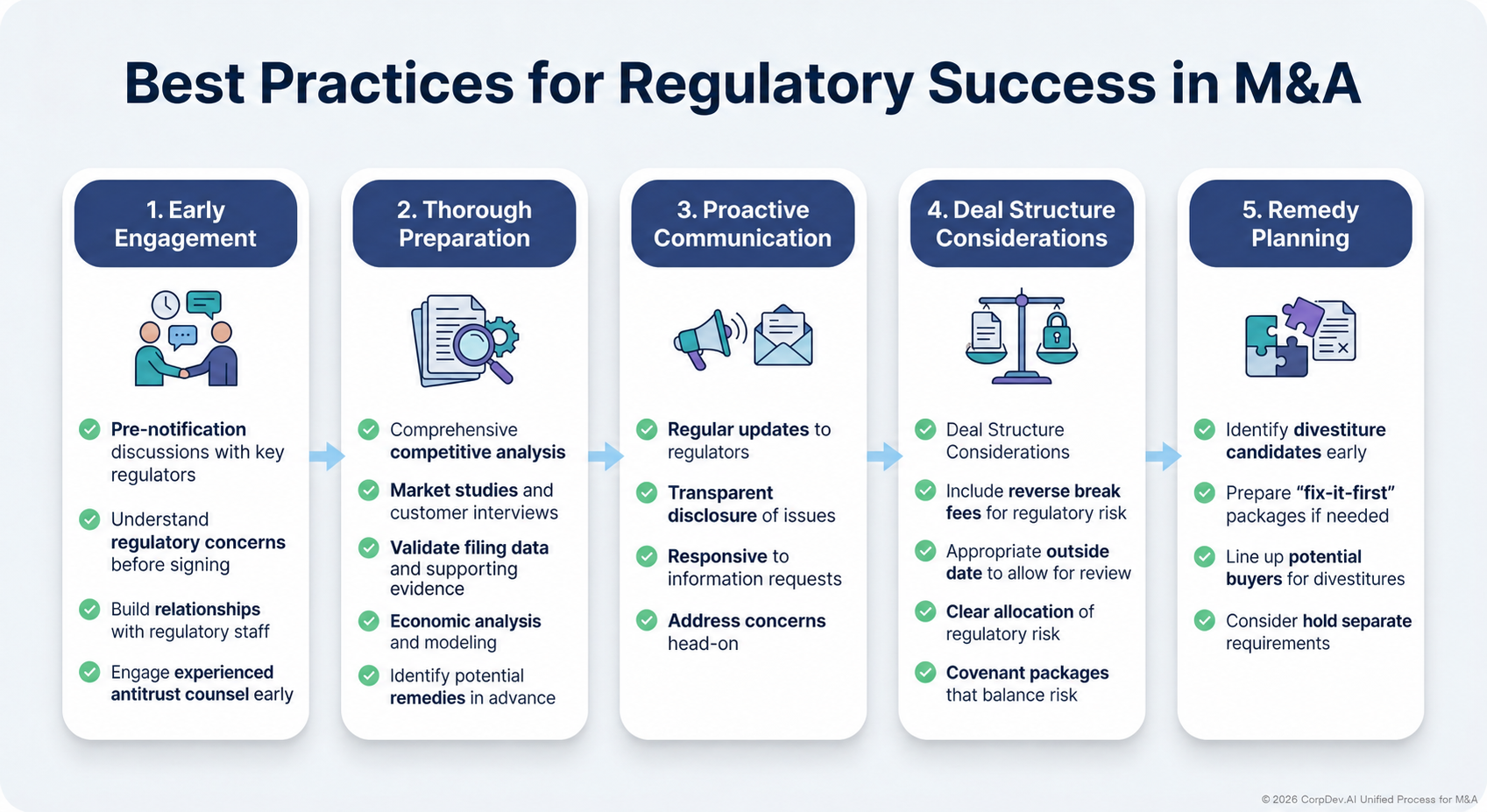 Early engagement: map approval requirements ↗Preparation: competition evidence ↗Communication and clearance evidence ↗Deal structure: negotiating authority ↗Remedy planning: regulatory downside ↗
Ask three separate questions
- Is a filing or approval required? This is a legal assessment specific to each jurisdiction and transaction.
- Can the deal be completed on acceptable terms? Filing thresholds do not answer the substantive competition, national-security, or sector question.
- What will the process do to value and execution? Model timing, remedies, costs, operating restrictions, and the ability to keep employees and customers.
Falling below a filing threshold does not mean there is no regulatory risk. The FTC notes that US agencies also investigate some completed mergers that later appear to have harmed competition. See its merger enforcement overview.
Build a jurisdiction and approval matrix
Ask counsel to map the legal entities, ultimate owners, customer and revenue footprint, assets, relevant activities, and deal structure. Include every jurisdiction where the parties operate or sell, not only where they are incorporated.
For each regime, the matrix records what the deal team needs to know:
| Field | What the deal team needs |
|---|---|
| Regime and authority | Competition, foreign investment, sector approval, or other process that applies |
| Trigger and conclusion | Filing required, possibly required, or not required; date of the analysis and its assumptions |
| Required information | Financial, ownership, market, customer, technology, and other data |
| Process owner | Internal counsel, local adviser, and the business owner of the data |
| Timing | Preparation, pre-notification, formal review, possible extensions, and dependencies |
| Substantive concern | Overlap, vertical (supplier–customer) relationship, sensitive activity, ownership, or other issue |
| Potential remedy | Structural, behavioral, governance, information-access, or other fix |
| Deal consequence | Conditions, long-stop date, financing, economics, and integration impact |
Treat the matrix as a living document. Record the date of each piece of advice and the facts it relies on. Reopen it if the perimeter grows, a co-investor joins, or the deal is restructured.
Check US HSR filing with counsel against current rules
The Hart-Scott-Rodino (HSR) Act requires the parties to certain US deals to notify the FTC and the Justice Department and wait before closing. The FTC's 2026 jurisdictional thresholds took effect on February 17, 2026:
- Size-of-transaction threshold: $133.9 million
- Upper threshold: $535.5 million
- Adjusted size-of-person thresholds: $26.8 million and $267.8 million
These figures alone do not decide whether a deal must be reported. Valuation, aggregation, exemptions, control, and other rules all matter. See the FTC's current thresholds, checked September 13, 2026.
Have HSR counsel determine the filing obligation, the rules that apply, preparation requirements, fees, and timetable from the current official guidance. Never infer the answer from the headline purchase price. Where the HSR waiting period applies, the parties cannot close until it has ended. The FTC premerger notification program is the starting point for current instructions.
Assess competition with evidence
Build a factual view of where the two businesses compete or supply each other. Useful inputs include:
- Customers' alternatives and how easily products substitute
- Pricing and bidding history
- Capacity, geography, and distribution
- Technology dependencies
- Internal strategy documents
Ask the business to describe the commercial logic accurately. What the team says internally to justify the deal should be consistent with the competitive facts presented externally. Keep records as counsel directs, and never present speculation as established market fact.
For any potential remedy, model the real business impact. A required divestiture can remove earnings, customers, technology, scale, or a capability central to the thesis. Treat a remedy as a change to the deal with its own economics, not a legal line item.
Map where the companies overlap, using public sources
Counsel's first competition questions are factual. Where do the two companies sell similar products, to the same kinds of customers, in the same places? The strategy slides rarely answer them, because they explain why the deal makes sense rather than where the businesses meet. A map built from public sources gives counsel a factual starting point and shows which internal data to request.
The map prepares counsel; it is not legal analysis. Deciding what counts as a relevant market, and whether an overlap matters, is counsel's job. Ask counsel before you start how the work should be prepared, labeled, and shared, because documents created about a deal can be requested by the reviewing authorities.
An abridged, hypothetical excerpt for two makers of gas detection equipment:
| Target product line | Closest buyer product | Customer types both name | Where both sell | Customers named by both |
|---|---|---|---|---|
| Handheld gas detectors | Portable detector range | Refineries, utilities | Germany, UK, US | Two utilities, from 2025 case studies |
| Fixed gas monitoring | No public evidence found | No public evidence found | No public evidence found | No public evidence found |
| Calibration services | Field service contracts | Utilities | UK | No public evidence found |
Counsel uses the map to decide which internal data to request, such as sales by product and country, bid records, and customer lists. A row marked "no public evidence found" is only as complete as the public record, which misses private contracts and unpublished customers.
The check that matters: open every cited source on rows that show an overlap, and confirm it says what the table says. A false overlap sends counsel after an issue that does not exist. A missed one leaves a real issue hidden until the internal data arrives.
Check foreign investment and sector approvals separately
National-security and foreign-investment screening can be separate from competition review. Sensitive technology, infrastructure, personal data, ownership, governance rights, and other facts can matter even when the target is small. For US matters, use Treasury's CFIUS resources and specialist advice to establish the deal's status and process. CFIUS is the Committee on Foreign Investment in the United States.
Sector rules can add approvals or constraints for regulated entities, permits, ownership, contracts, or licenses. Ask the relevant functional leaders and counsel to identify the authorities involved and the evidence each needs. Competition clearance covers competition only; track every other approval on its own.
Set information controls before the data room opens
Decide who may see what before opening a data room. In deals between competitors, counsel may require clean teams (restricted groups that review competitively sensitive information under agreed rules), aggregation, redaction, and limits on sharing competitively sensitive information. Define who may contact customers, suppliers, or regulators, and what they may say.
Integration planning should prepare the future business without giving the buyer control, or coordinating the two companies, before closing. Have counsel review planned pre-close activities, operating covenants, and joint workstreams. Signing the agreement does not transfer ownership.
Model the regulatory downside before you commit
Compare four illustrative scenarios: completion with no remedy, delayed completion, completion with a defined remedy, and termination. Resist attaching probabilities just to make the model look complete. Explain the evidence behind each scenario and the limits of counsel's view.
The table shows what each adverse scenario changes in the model and the question it forces leadership to answer.
| Scenario | What changes in the model | Decision to make |
|---|---|---|
| Delay | Financing costs, adviser effort, retention, customer uncertainty, and later synergies | Can the parties fund and run the business through the delay? |
| Divestiture | Lost earnings, separation costs, sale proceeds, and remaining strategic fit | Does the smaller perimeter still support the thesis? |
| Operating restrictions | Compliance resources, governance, information limits, and constrained integration | Can the business run the approved operating model? |
| Termination | Contractual payments where applicable, sunk costs, and alternative strategy | Is the downside acceptable compared with other uses of capital? |
Use the same timing assumptions in the regulatory plan, sources and uses, valuation model, and integration schedule.
Turn the plan into negotiating authority
Before binding approval, agree the following with counsel:
- The remedies you would accept
- The approvals required
- Efforts obligations: how far each party must go to obtain approval
- Information cooperation between the parties
- Long-stop mechanics, including the date after which a party can walk away if approvals are still outstanding
- Who bears the risk if approval fails
Define which changes require going back to the committee or board.
Never authorize an open-ended commitment to obtain approval without understanding what it could cost. A narrow commitment has its own cost: it makes the deal less certain for the seller. Present that tradeoff as part of the negotiating mandate.
Close on evidence, not optimism
Keep a conditions tracker. For each required approval, record the evidence received, any conditions attached, the responsible owner, and confirmation that the final transaction matches the approved perimeter. Counsel confirms that each condition is legally satisfied or validly waived where applicable. Treasury and the closing team work from the same status record.
After closing, assign owners for any ongoing undertakings, reporting duties, access restrictions, divestiture obligations, or other commitments. Put deadlines and escalation routes in the operating plan. Regulatory obligations can outlast the deal team.
Give the committee a short regulatory section
The regulatory section of the committee pack should state:
- The filing map
- Substantive concerns
- Realistic process dependencies
- Downside economics
- The proposed allocation of risk in the contract
- Open questions and the decision required
Keep detailed legal analysis in supporting materials, and protect confidentiality and privilege as counsel advises.
Continue with cross-border M&A, deal structure, and issue and risk management.
© 2026 CorpDev.Ai Unified Process for M&A