
Target Identification & Sourcing
Sourcing finds the companies that fit your strategy and builds relationships with their owners, often long before they are for sale. Success is a set of well-understood companies and working relationships. The size of the contact list and the reply rate to acquisition emails say little about either.
For an established company, reputation matters. A thoughtful approach can start a relationship that pays off years later. A clumsy one can confuse owners, alarm customers and partners, or contradict a promise a business unit has already made.
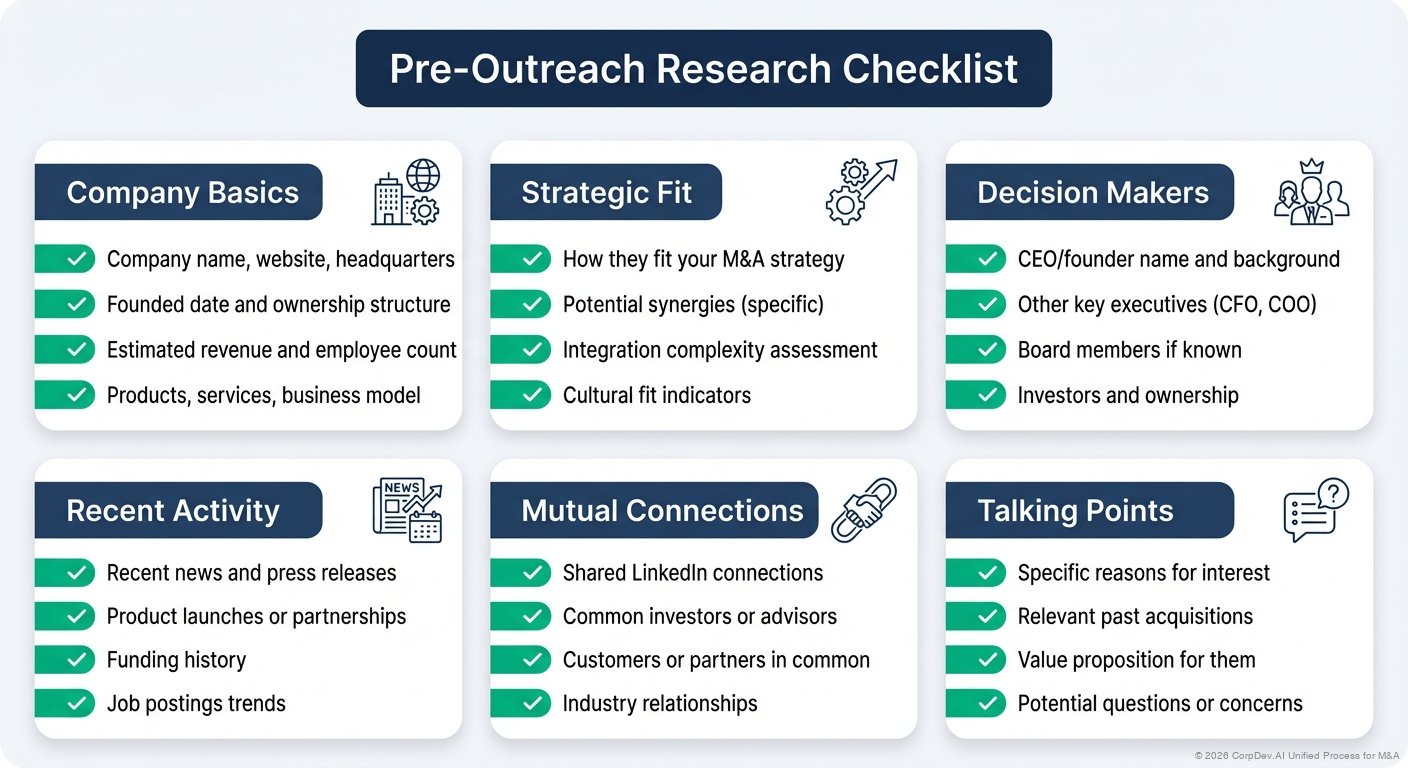 Company basics: build an evidence-based market map ↗Strategic fit: translate the thesis into a search brief ↗Decision-makers: coordinate the relationship ↗Recent activity: maintain current research ↗Mutual connections: coordinate before approaching ↗Talking points: make the first conversation useful ↗
Text links for this illustration
Turn the thesis into a one-page search brief
Write the brief before you ask advisers for lists or assign research. It covers:
- The capability or market position you need
- Why you need to own it rather than partner for it
- The characteristics a target must have, and what rules a company out
- The business sponsor
- The evidence that would justify deeper work
Say where you are flexible. A particular technology may be essential while a preferred region is negotiable. If both go into one unexplained score, you cannot compare targets sensibly.
Ask the sponsor what would make an apparent match unusable. Examples include a product that cannot serve your customers' environment, a business that depends on a founder who would not stay, or a carve-out whose standalone costs break the thesis. Treat these as questions to research. Never assume one applies to a specific company without evidence.
Map the market from several directions
Start with the customer's problem and the value chain. Map competing solutions, adjacent capabilities, suppliers, distributors, and substitutes. Then find companies through their disclosures, product documentation, customer references, ownership records, and market sources.
People add what databases miss. Business leaders, product teams, customers, suppliers, investors, and advisers may know of a capability or an ownership change worth exploring. Record who said it, and mark whether it is direct knowledge, inference, or rumor.
Keep a short evidence card for each company, so anyone who picks it up later can see why it is on the list:
| Field | What to capture |
|---|---|
| Identity and scope | The business, its legal parent, the relevant division, and known owners |
| Fit with the thesis | The specific capability or market role, with evidence |
| Business quality | What is known about customers, economics, durability, and dependencies |
| Why it is worth more to you | A testable explanation of what you could improve as owner |
| Route to the owner | Existing contacts, the internal relationship owner, and the right introduction |
| Unknowns | Questions that block qualification |
| Source quality | Links, dates, and whether each fact is verified or estimated |
| Decision | Research, approach, monitor, or exclude, with the reason |
Keep financial estimates out of outreach unless the company has disclosed them and using them is appropriate. Never present a third-party estimate as inside knowledge of the owner's business.
Search in other words, then audit the rejects
Searches find companies that describe themselves the way you describe your need. Many good targets do not. A business that sells what you call "predictive maintenance" may call itself "asset reliability services," and an industry code may file a software company under engineering consulting. The second blind spot is worse. Once a screen excludes a company, nobody looks at it again, so screening mistakes stay invisible.
AI search helps with both. Describe the business in plain words and it returns companies your own vocabulary would have missed. Point it at the excluded names and it will argue for putting some back. That second step, the false-negative audit, is the one teams skip, and it is the only one that tests the screen itself.
A hypothetical example:
| Company | How it surfaced | Evidence quoted | Next step |
|---|---|---|---|
| Company A | Different words: "asset reliability services" | "We guarantee uptime for rotating equipment using sensor data" (services page) | Add; confirm it owns its analytics software |
| Company B | Wrongly excluded as a "hardware distributor" | Latest annual report: most revenue now comes from monitoring subscriptions | Reinstate; the exclusion relied on an old industry code |
| Company C | Different words: "condition monitoring" | Product page describes vibration analytics sold to utilities | Research; ownership unclear |
Treat every proposal as a lead. The sourcing analyst opens the quoted source, confirms the company's identity, and checks existing relationship records before a name joins the list. Anything a search result claims about revenue, competitors, or willingness to sell stays unconfirmed, and outreach and stage changes stay with the relationship owner. The check that matters is the reinstatement count: if the audit puts several excluded companies back, fix the screen, not just those names. See AI in M&A for the broader controls.
In CorpDev.Ai
Describe the capability in plain English in AI Metasearch. Add each exclusion criterion as a question in an AI column; the reasoning under each answer shows why a company was ruled out when you audit the rejects.
Coordinate inside the company before any approach
Check your company's history with the target first. It may be a customer, supplier, competitor, portfolio investment, or partner of several business units. Name one person to own the external relationship, and agree internally on the purpose of the approach.
Before anyone contacts the owner, decide who speaks, what they may say, and what they must not promise without further approval. An executive introduction can open doors. It should not create expectations about valuation, roles, or deal certainty that the company has not approved.
When an adviser brings the opportunity, clarify the process, the seller's objectives, information access, deadlines, and any fees or engagement obligations before you commit resources. Direct sourcing does not guarantee a lower price or an absence of competition. An adviser-run process does not automatically mean a poor investment.
Make the first conversation useful
A credible first approach shows you know the business and explains why a conversation could be worthwhile. Skip the claim that every target is a "perfect strategic fit." Never disguise an acquisition approach as customer research.
An outline to adapt:
We are building [specific capability or market priority]. Your work in [area we can verify] looks relevant because [concrete connection]. I lead corporate development at [company] and would value a first conversation about your priorities and whether a strategic relationship could make sense. We have not formed a transaction proposal. If the timing is wrong, I will respect that.
Adjust the wording to the actual mandate and relationship. A known owner may warrant a personal introduction. An active sale process needs a direct response to its requirements. Never imply that a commercial partnership is on offer when you are authorized only to ask about an acquisition.
Qualify with questions, not a pitch
Early conversations should show whether there is a basis for more work. Learn the owner's objectives, preferred timing, business priorities, ownership situation, and openness to different structures. Ask what must be preserved for the business to succeed under a new owner.
Share enough about your strategy and process for the owner to judge your credibility. Do not press for sensitive details before confidentiality and information-sharing rules are in place. If the companies compete, have counsel set the boundaries; the FTC emphasizes safeguards around competitively sensitive information. FTC guidance.
After each conversation, record what you learned, what you promised, who follows up, and whether the thesis changed. A friendly meeting does not mean the owner is ready for a deal.
Advance a company only with a concrete reason
A company moves from sourcing into active evaluation when you have:
- A named business sponsor
- Evidence of strategic fit
- A plausible perimeter, meaning what exactly would be bought
- A workable way to get information
- A defined next decision
Record the open questions about value instead of building a precise valuation from public fragments.
When a relationship is valuable but not ready for a deal, agree a real reason to reconnect. A product milestone, an ownership change, or your own strategy review all beat an automated monthly email. If an owner asks you to stop contacting them, stop.
Review what sourcing found and what it missed
Review coverage by thesis, the quality of qualified opportunities, relationship continuity, and the reasons targets were rejected. Compare channels with care. One adviser may bring mature sale processes while your own research produces early relationships, so raw response or conversion rates are not directly comparable.
A useful review asks four questions:
- Which relevant companies did we miss?
- Which search assumptions proved wrong?
- Which introductions improved access?
- Which repeated approaches produced nothing?
The false-negative audit above answers the first two. Update the search brief and relationship map with what you learn.
The common failures are duplicated outreach, promises made before approval, mistaking a willing seller for a good fit, and treating every conversation as a deal. Good sourcing leaves the company better informed even when no deal follows.
Continue with building an M&A pipeline to keep the records current and M&A strategy development to refine the theses behind the search.
© 2026 CorpDev.Ai Unified Process for M&A