
Merger Model & Accretion/Dilution Analysis
A merger model shows how an acquisition changes the buyer's financial statements, earnings per share (EPS), cash generation, and debt. It connects the negotiated deal to how the company will actually pay for it and report it.
Accretion, a rise in EPS, is an output, not proof that the deal creates value. A deal can raise EPS while destroying value, or lower near-term EPS while creating value over time. Review EPS alongside cash flow, returns, leverage, integration risk, and other uses of the capital.
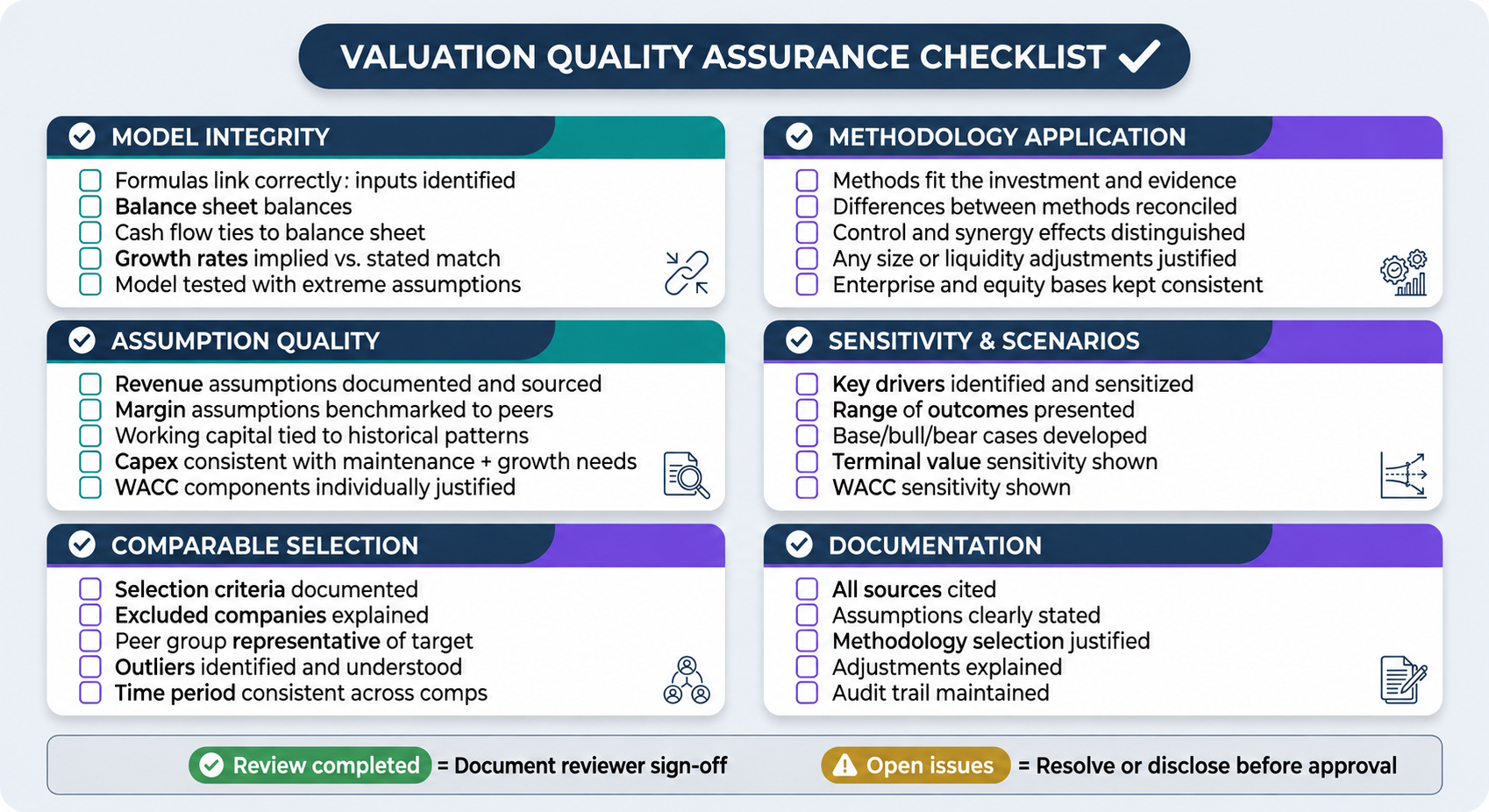 Model integrity ↗Assumption quality ↗Comparable selection ↗Methodology application ↗Sensitivity and scenarios ↗Documentation ↗Review before presentation ↗
Define what the model is for and what it covers
State the deal perimeter, accounting framework, valuation date, assumed closing date, financing structure, and forecast period. Say whether the model supports screening, a binding approval, financing, external communication, or post-close planning.
Mark screening assumptions as provisional. Purchase accounting, tax treatment, financing terms, and diluted share counts need specialist input before a binding decision. Never let a preliminary model become the approval model just because its numbers have already appeared in slides.
Split the workbook into schedules with named owners
Each schedule should have a clear owner or reviewer, so every number has someone accountable for it.
| Schedule | Contents | Primary owner or reviewer |
|---|---|---|
| Control and assumptions | Case selection, dates, currencies, versions, and key inputs | CorpDev model owner |
| Buyer standalone | Historical and forecast financials, shares, existing debt, and liquidity | FP&A and treasury |
| Target standalone | Reported and normalized results, operating drivers, cash flow | Deal team and diligence leads |
| Purchase price | Bridge from enterprise value to equity value, consideration, escrow, rollover, contingent payments | CorpDev, legal, and finance |
| Sources and uses | Funding sources and cash needed at closing | Treasury |
| Acquisition accounting | Identifiable assets and liabilities, goodwill, later charges | Accounting with valuation specialists |
| Financing | Debt balances, interest, repayments, fees, liquidity, and covenants | Treasury |
| Synergies and integration | Timing, costs, tax effects, dis-synergies, and owners | Business sponsor and integration |
| Combined statements | Income statement, balance sheet, cash flow, and EPS | Finance |
| Sensitivities and checks | Price, mix, timing, performance, financing, and error checks | Independent reviewer |
Use consistent signs, units, dates, and input conventions. Keep sources next to important assumptions, and preserve the original approved version.
Reconcile the purchase price to the latest terms
Start with a defined bridge from enterprise value to equity value. Include cash, debt, other relevant claims, working-capital adjustments, and the actual consideration terms. Deferred payments, earnouts, escrow, and rollover each affect funding and accounting differently, so never collapse them into a single cash price.
Keep the model in line with the latest negotiated terms. A change in price, in the definitions of cash and debt, or in closing adjustments should flow through sources and uses and every output without manual patches.
Make sources and uses balance
Sources and uses must balance. Separate the cash needed from noncash consideration, and show assumed or refinanced debt consistently.
Illustrative cash transaction, in millions:
| Uses | Amount | Sources | Amount |
|---|---|---|---|
| Seller equity consideration | 300 | Buyer balance-sheet cash | 140 |
| Refinance target debt | 50 | New acquisition debt | 225 |
| Transaction and financing fees | 15 | ||
| Total uses | 365 | Total sources | 365 |
This example assumes no target cash is available to fund the deal, and it excludes contingent payments and other adjustments. The buyer must still keep enough operating liquidity after contributing $140 million. Available cash is not the same as the total cash reported on the balance sheet.
Model financing explicitly
Project opening debt, new borrowing, required and optional repayments, closing debt, and interest. Document the convention for average balances and timing. Include fees and their accounting treatment, with specialist input.
Tie repayment capacity to the cash left after operating needs, taxes, capital spending, working capital, integration, and required liquidity. Never assume debt is repaid from cash that is restricted, trapped, or needed elsewhere in the business.
Interest and cash-sweep calculations often create a circular reference: interest depends on debt, and debt depends on the cash left after interest. Solve it in a controlled, documented way. Add checks that show when the calculation fails to converge or a sensitivity table has stopped recalculating. A model that silently relies on an old circular value is not ready for a decision.
Build acquisition accounting into the model
The accounting team should identify the applicable framework and how the deal is classified. For business combinations under IFRS, IFRS 3 covers the recognition and measurement of acquired assets and liabilities, goodwill, and related disclosures. See the IFRS Foundation's standard overview.
Model the relevant effects, such as:
- Amortization of identifiable intangible assets
- Fair-value adjustments to inventory or other assets
- Deferred taxes and the amortization of financing fees
- The treatment of contingent or employment-linked payments
Treatment depends on the facts and the reporting framework. Avoid a single goodwill plug that hides unreviewed assumptions.
Keep accounting charges and cash spending apart. Noncash amortization can lower reported EPS even though the cash left the business at closing, as part of the price. Integration spending can matter a great deal economically even when an adjusted earnings figure leaves it out.
Phase synergies and their costs over time
Build synergies from individual initiatives with owners and start dates. Model the ramp-up, one-time costs, recurring costs, tax effects, capital expenditure, and dis-synergies. Tie headcount savings to actual roles and dates, and revenue benefits to customers, capacity, and the cost of serving them.
Keep the annualized run rate separate from the benefit earned in the period. An initiative that reaches a $12 million annual run rate in December does not add $12 million to that year's earnings. Model each benefit in the same periods as the combined statements.
Never count a target improvement in both the standalone forecast and the synergy schedule. Keep a bridge that shows which changes belong to which case.
Calculate accretion and dilution
A simplified full-year calculation:
Combined net income attributable to common shareholders
  = Buyer standalone net income
  + Target contribution for the ownership period
  + After-tax synergies
  − After-tax integration and other applicable charges
  − Incremental after-tax financing cost
  − Lost after-tax interest income on cash used
  ± Other transaction and accounting effects

Combined diluted EPS = Combined common net income / Combined diluted shares
Accretion or dilution = Combined EPS / Buyer standalone EPS − 1
Use properly weighted diluted shares and the actual ownership period. New shares issued, share-based awards, convertible instruments, and other items may need more detailed treatment. Have accounting review the share count and the presentation.
When target debt is repaid or refinanced, first remove the after-tax interest already in the target's earnings, then charge the new financing cost. Alternatively, define the financing adjustment as new interest minus the target interest eliminated. Pick one convention and use it throughout, so the model never counts both debt structures.
Worked example: EPS for an all-cash deal
Hypothetical full-year, all-cash acquisition: The buyer earns $200 million with 100 million diluted shares, so standalone EPS is $2.00. The deal adds the following after-tax amounts, in millions:
| Increment | Amount |
|---|---|
| Target earnings contribution | 30 |
| Synergies | 8 |
| Financing cost | (10) |
| Lost interest income | (2) |
| Incremental amortization | (6) |
| Integration expense | (4) |
| Net increase in common earnings | 16 |
Combined net income is $216 million, EPS is $2.16, and reported accretion under these assumptions is 8%. An adjusted figure that excludes the $4 million integration expense would show $2.20, or 10% accretion. That figure must be labeled and reconciled, because the expense and its cash cost remain.
The calculation says nothing about whether the buyer paid too much. For that, compare the price with the present value of the acquired cash flows and with the returns available elsewhere.
Test the closing date and the mix of cash and shares
A midyear close changes the target's contribution, synergy timing, financing costs, fees, and share weighting. Never pair a full year of target earnings with a partial year of financing cost.
When paying in shares, model the exchange ratio, the sensitivity to the buyer's share price, shares issued, ownership dilution, and any contractual protections. A fixed number of shares and a fixed dollar value behave differently when the buyer's share price moves.
Show sensitivities to price, interest rate, financing mix, closing date, synergy timing, and target performance. Include combined downside scenarios in which the risks interact.
Judge the deal on more than EPS
The approval package should include:
- Reported EPS, and any adjusted EPS with its reconciliation
- Operating cash flow and free cash flow
- Liquidity, leverage, and debt repayment
- Covenant headroom, where applicable
- Returns measured against the company's capital-allocation framework
Ask whether the buyer could finance the downside without harming its existing business. A deal can look accretive while it consumes cash, narrows strategic options, and creates refinancing risk the company cannot accept.
Have a second reviewer check the model
Give a reviewer the actual workbook, terms, and assumptions. Check formula ranges, signs, hard-coded values, circular calculations, and links between schedules. Change the closing date and key assumptions to confirm that dependent outputs respond correctly. The model owner should resolve each finding and preserve the reviewed version used for approval.
Check, freeze, and hand over the model
Build visible checks for sources and uses, balance-sheet balance, cash-flow reconciliation, debt roll-forward, share count, scenario selection, and consistency with committee materials. Recalculate a simplified EPS case independently, and change inputs deliberately to test that each change flows through every schedule.
At approval, freeze the model, sources, definitions, and assumptions. At closing, reconcile the final terms and funding to that version. Give finance and integration teams the schedules they need to track the acquired business and the promised benefits.
Continue with DCF analysis, deal structure, and value creation planning.
© 2026 CorpDev.Ai Unified Process for M&A