
Sourcing Cadence & Pipeline Management
Sourcing finds the companies that fit your strategy and builds relationships with them before they are for sale. Its output is a short set of credible options the company understands well enough to pursue when timing, price, and readiness line up. A long company list or a high count of outbound emails is activity, not that output.
Three groups share the work. Strategy and business leaders define the capability gaps. The sourcing lead owns coverage of the market and coordinates relationships. Deal leads qualify the situations that could become transactions. The Head of CorpDev allocates effort across all three, rather than letting the latest banker-run sale set the agenda.
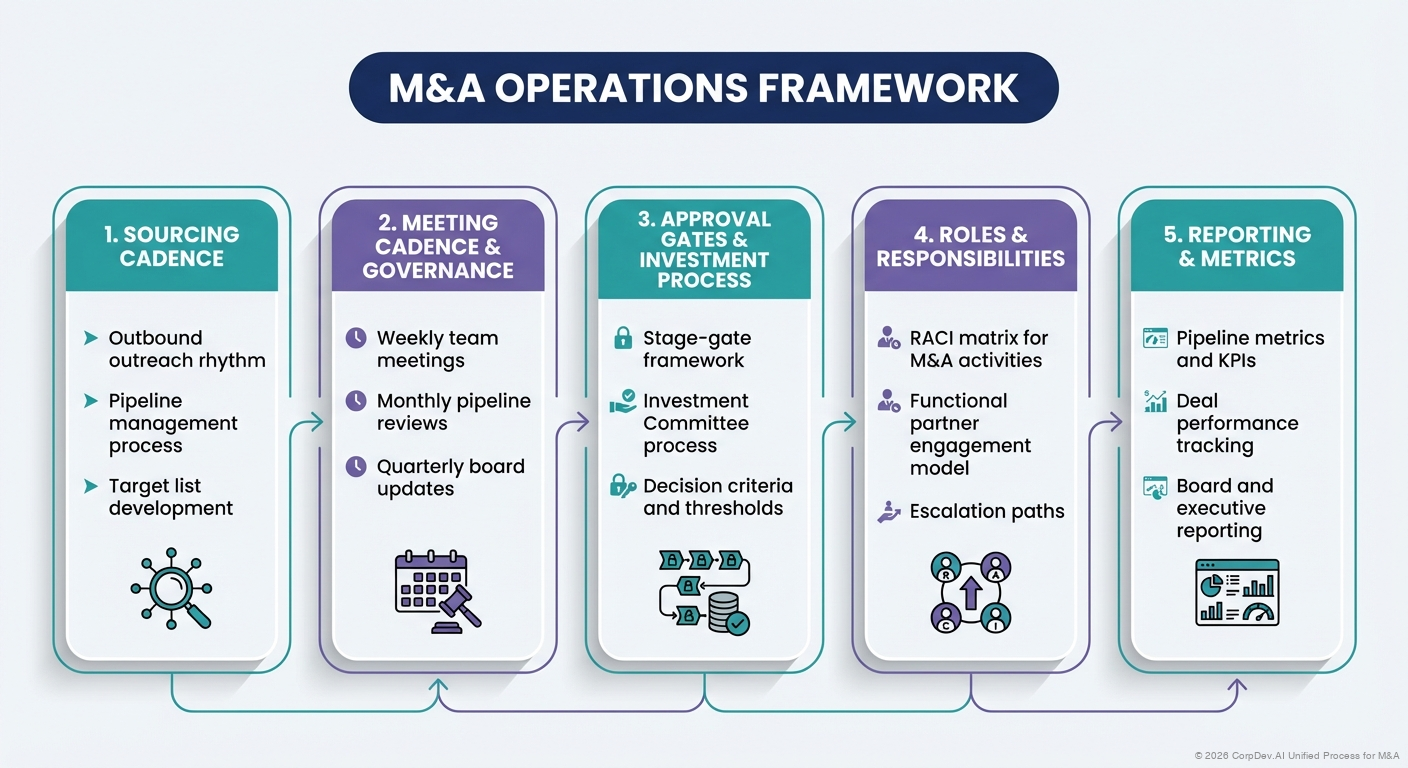 Sourcing cadence ↗Meeting cadence and governance ↗Approval gates and investment process ↗Roles and responsibilities ↗Reporting and metrics ↗
Write a buying brief for each theme
Turn a broad priority such as "expand internationally" into a theme brief: a specific customer problem, capability, geography, and the business that would receive the acquisition. Include the internal-build and partnership alternatives. If the business cannot explain what it would do with the company it buys, the theme is not ready for broad outreach.
SOURCING THEME BRIEF
Portfolio priority and business sponsor:
Customer or operating problem to solve:
Capabilities, assets, and geographic presence required:
Target characteristics that matter, and why:
Exclusions and unacceptable dependencies:
Build, partner, or buy alternatives:
Integration approach and receiving business:
Indicative capital and resource limits:
Evidence that would qualify a target:
Evidence that would disqualify one:
Coverage owner and review date:
Use size filters to manage research, but keep exceptions that could solve the problem better. A company outside the initial revenue range can still be worth a conversation if its capability and integration profile are compelling.
Build the target universe and record where it is thin
Combine several kinds of source:
- Company databases and public filings
- Industry associations, and customer and supplier ecosystems
- Specialist advisers and executive networks
- Original research
Record which part of the market each source covers well and where it is weak.
Remove duplicate legal entities and brands. Separate subsidiaries from businesses that can be bought on their own, service revenue from product revenue, and adjacent businesses from direct fits. A company's marketing category is a clue, not proof of what it can do.
Each target record needs the date of its source, what is known about ownership, its relevance to a theme, and a confidence level. Where private-company figures are estimated, keep the range and the estimation method. Otherwise an unverified revenue estimate becomes an exact number in the investment deck months later. Keep raw research, verified facts, and approved relationship actions in separate fields.
Review coverage gaps with business experts. They know companies with important capabilities that commercial databases classify poorly.
Judge strategic fit separately from whether a deal can happen
A valuable target may not be available, and an available target may not be valuable. Keep both visible. The table shows six dimensions and what each one leads to.
| Dimension | Useful evidence | What it leads to |
|---|---|---|
| Strategic fit | Product, customers, assets, capability, receiving business | Prioritize or exclude |
| Economic plausibility | Business quality, capital needs, owner's expectations | Valuation questions to develop |
| Integration feasibility | Systems, leadership, culture, dependencies | Involving the receiving functions |
| Ownership and timing | Actual ownership, stated objectives, a credible trigger for a sale | Choosing how to engage |
| Access | Trusted introduction, prior relationship, permitted adviser route | A relationship action |
| Readiness | Sponsor, resources, available capital, competing commitments | Whether to pursue now |
Avoid collapsing this into a single score that hides the judgments behind it. A disqualifying issue must stay visible even when every other factor scores well.
Give each target one relationship owner
At a large company, directors, business units, investors, and advisers may all know the same target. Before anyone reaches out, find the existing relationships and agree who coordinates contact. Record introductions and commitments, so the company does not approach the same CEO three times with three different messages.
The relationship owner should understand what the target's owners want and have a credible reason to talk. When a business leader offers an introduction, brief that person on the strategic context and the limits of the conversation.
A good first message is specific. It says what you understand about the business, which strategic topic is worth discussing, and why your company is a relevant counterpart. Do not present an unverified valuation or imply authority to acquire that nobody has granted.
Keep relationship notes factual and respectful: what was said, by whom, and when, and whether it was stated directly or inferred. Access to the notes and their use follow company policy.
Run three sourcing rhythms at different speeds
Each rhythm asks a different question, so each produces a different result.
| Rhythm | Question it asks | Result |
|---|---|---|
| Theme review (periodic) | Does the priority still matter, is coverage adequate, and is the company still ready to act? | Strategy, business sponsors, and CorpDev change the mandate when needed |
| Relationship review | What is the next meaningful interaction with each high-priority target? | A product discussion, executive meeting, conference conversation, or a deliberate pause |
| Live opportunity review | Does a seller process or credible opening fit the existing thesis? | Sponsor, authority, timetable, information needs, and capacity confirmed before a deal team is assigned |
Contact frequency should follow the relationship, not a blanket outreach quota. Keep records current day to day, capturing new evidence and commitments rather than activity for its own sake.
Give every pipeline state an exit rule
Use distinct states:
- Researched universe
- Qualified target
- Relationship development
- Actionable opportunity
- Live transaction
- Parked
- Declined
A signed NDA does not mean a target is strategically qualified.
For each state, document the evidence required, the owner, the next action, and the review trigger. A parked target needs a reason and a catalyst to watch for: an ownership change, a product milestone, capital becoming available, or a planned strategy review. A declined target needs a reason that can be revisited if the facts change.
The weekly review should ask whether records are current and whether each active item still deserves resources. It should not push owners to invent stage progress. Remove stale commitments and keep the relationship history.
Send leadership a one-page weekly sourcing brief
The brief reports what changed and what needs a decision, theme by theme.
SOURCING BRIEF (theme / week / owner)
Coverage changes: new segments, missing segments, evidence gaps:
Newly qualified targets, and why:
Priority relationships: last meaningful contact / next action / owner:
Actionable situations: trigger / sponsor / decision required / deadline:
Targets parked or declined, and why:
Relationship conflicts across businesses to resolve:
Research or adviser capacity requested:
Findings that may change the theme:
Commitments made to outside parties:
Attach a few decision-ready target cards. Put the full universe and detailed research behind links, rather than walking leadership through a spreadsheet of companies that need no decision.
Example: one real opportunity, not three prospects
This example is hypothetical. A company wants a specialist testing capability, and the funnel narrows quickly:
| Step | Companies |
|---|---|
| Identified in research | 28 |
| Have the required accreditation and customer access | 8 |
| Also fit the planned operating model | 3 |
| Owner open to discussions now | 1 |
Of the three that fit, the other two owners prefer to stay independent but welcome a commercial relationship.
The pipeline should show one actionable opportunity and two strategic relationships, not three near-term acquisition prospects. The sponsor can fund diligence on the first while business development explores permitted partnerships with the other two. CorpDev watches for ownership and strategic changes without making the pipeline look more actionable than it is.
Sweep the target list for trigger events every week
In the example, two owners prefer independence today. What usually changes that is an event. A founder hands over the CEO role. A private equity owner nears the end of its holding period. A parent calls a division non-core. A lender grants a covenant waiver. Most teams notice these only when someone happens to read the news. If the first you hear of it is a banker's call, the company is already in a sale process.
A weekly sweep checks every company on the priority list for four kinds of event and ranks what it finds by relevance to the theme brief. The ranking is the point. A leadership change at a company with the accreditation you need matters more than a funding round at a company you would never buy.
A good sweep is mostly "no events found," with a few ranked rows. A hypothetical example:
| Company (pipeline state) | Event, date, and source | What it could mean | Relevance to the theme |
|---|---|---|---|
| Accredited lab inside a diversified industrial group (parked) | Parent calls the testing division "non-core" on its earnings call, 8 September, call transcript | The parent may sell the division | High: holds the required accreditation; take it out of parked |
| Founder-owned specialist lab (relationship development) | Founder steps down as CEO and an outside CEO is appointed, 5 September, press release | Ownership and succession questions may reopen | High: one of the three that fit the operating model |
| Private equity–backed competitor (declined) | Raises growth equity, 9 September, press release | A sale is less likely in the near term | Low: declined for its footprint; no action |
High-relevance rows go into the "actionable situations" line of the weekly sourcing brief. Each gets a relationship owner and a next step, such as a note to the new CEO or a request to meet the parent's strategy team. Parked targets whose catalyst has occurred go back into active review. An event is a reason to investigate timing, not proof that anyone intends to sell.
In CorpDev.Ai
Track each company's news on its pipeline card: leadership changes, funding, M&A signals, product and partnership announcements, each rated by significance. A significant one labels the card "Engagement Recommended," so the weekly review starts there.
The one check that matters: open the source for every event you act on and confirm that it concerns the same legal entity. Similar company names and brands shared across subsidiaries make this an easy mistake. A note about the wrong company's news can undo years of relationship work.
Measure conversion fairly and learn from the misses
Track:
- Qualified coverage for each priority
- Evidence quality and relationship access
- Response rates within comparable groups
- Observed stage conversion
- The reasons opportunities stop
Compare like with like, by channel and observation period. A proprietary relationship that develops over years is not directly comparable with a banker-run auction that enters at a later stage.
Check whether declined deals were rejected for known exclusions that should have been caught earlier. Also look for false negatives: companies dismissed on a superficial classification that later proved relevant. Both lessons improve screening.
When an opportunity passes to a deal lead, hand over the theme brief, source-backed target facts, relationship history, seller objectives, open questions, the sponsor, and any commitments made. See Target Sourcing, Approval Gates, and Reporting & Metrics.
© 2026 CorpDev.Ai Unified Process for M&A