
Meeting Cadence & Governance
A good M&A meeting cadence shortens the time between learning something important and getting a decision from someone accountable. Build the calendar around decisions, dependencies, and the point at which waiting becomes expensive. Updates for every stakeholder are the wrong starting point.
The Head of CorpDev designs the set of meetings. Each meeting also needs a chair who can make its decisions, an owner for the pre-read, and someone who records the decisions. When the chair cannot authorize an action, spell out the route to the body that can.
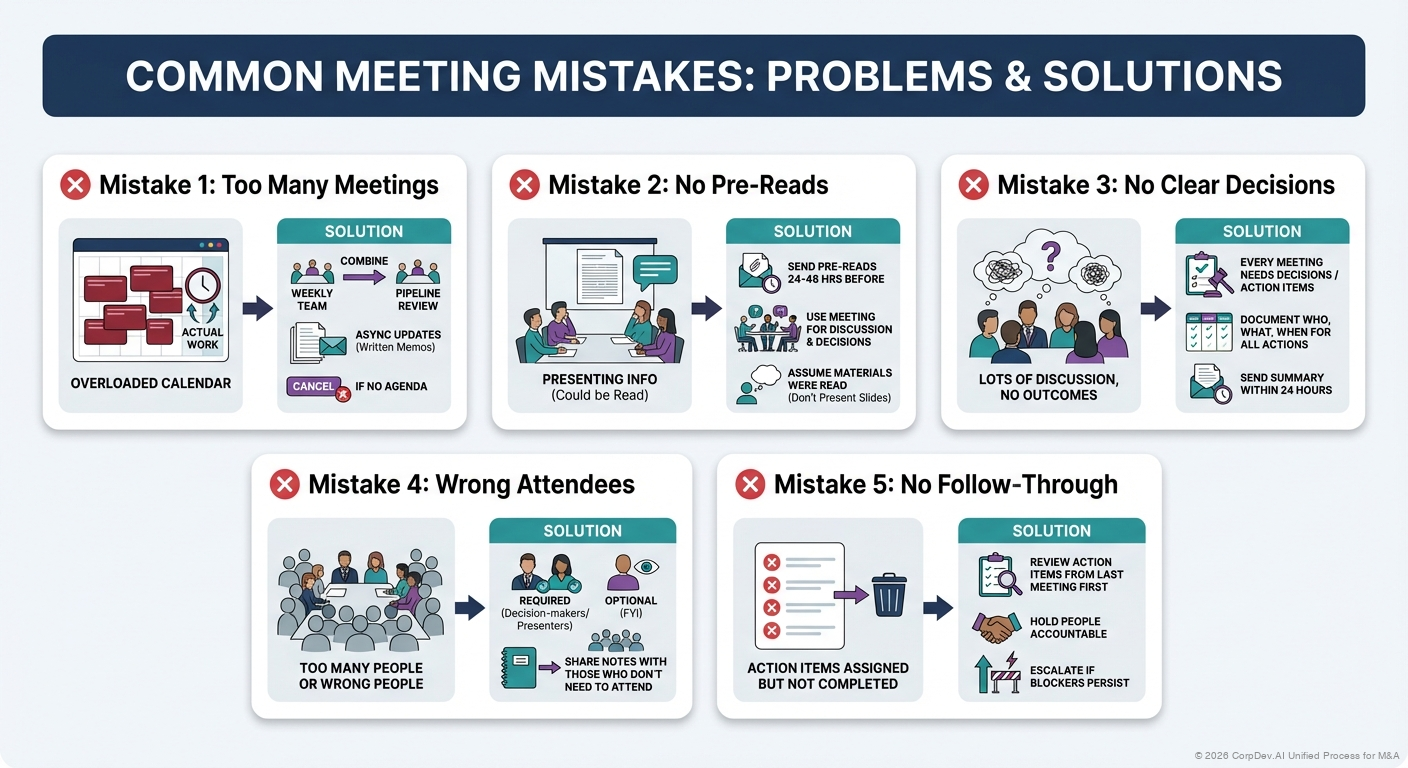 Reduce duplicate meetings ↗Prepare decision-ready pre-reads ↗Make decisions explicit ↗Bring the right decision makers ↗Track decisions and follow-through ↗
Give each forum a distinct job
The cadence below is illustrative, not a required schedule. Adjust frequency to the volume and risk of the work.
| Forum | Decision it makes | Who must be there | Input | Output that lasts |
|---|---|---|---|---|
| Weekly CorpDev allocation | Where the team spends its time next | CorpDev lead and deal and sourcing owners | Changed opportunities, actions, capacity | Prioritized work and relationship actions |
| Live-deal workstream review | How to resolve dependencies across functions | Deal lead and affected workstream owners | Exceptions, evidence gaps, critical path | Actions, decisions on issues, escalations |
| Executive pipeline review (periodic) | Which opportunities get sponsors and resources | Executive sponsors, CorpDev, Finance | Strategic coverage and resource trade-offs | Sponsor commitments and priority changes |
| Investment committee | Whether to authorize a defined next commitment | Authorized members and relevant experts | Decision memo, model, significant risks | Recorded approval, conditions, or rejection |
| Integration steering | Which interventions protect operating value | Business sponsor, integration and functional leaders | Benefits, service continuity, dependencies | Resource and operating decisions |
| Board | Strategic oversight and reserved approvals | Directors and designated management | Board decision or performance pack | Guidance and formal decisions, as appropriate |
Cancel a recurring meeting when it has no decision or coordination to handle, and send a short update instead. Allow approval outside a meeting only where company policy permits it.
Run the weekly CorpDev meeting to allocate time
Start with what changed since the last review: new information, a seller's response, a blocked introduction, a slipped milestone, or a shift in strategic priority. Do not walk through every target in the database.
For each opportunity that needs discussion, ask:
- What changed, and how credible is the evidence?
- Does the change alter the next best action or the priority?
- Who will do the work, and what will they stop doing to make room?
- What visible result should come back to the next review?
Keep long-term relationship targets separate from live transactions. A company that is not for sale may deserve careful continued coverage without taking a live-deal slot. Give it a revisit trigger so it does not show as overdue forever.
One workable agenda is ten minutes on changed priorities, twenty on allocation decisions, and ten on blockers. The timings are a facilitation choice. The real test is whether people leave with a clearer, different work plan.
Use the live-deal review only for exceptions
The deal lead keeps the combined critical path current outside the meeting, and workstream owners update findings and milestones beforehand. Spend meeting time on matters that need coordination or judgment, such as:
- Commercial and financial data that disagree
- Revenue plans that depend on product plans
- People who are not available when needed
- Conditions that could change the offer
A workstream that reports "green" should be able to say what evidence it received, what it concluded, and what remains untested. Percent-complete reporting without those facts creates false confidence.
Some topics need a smaller audience. Counsel may require a separate session or restricted materials for privileged or competitively sensitive information. The main meeting then receives the conclusion it needs to decide, within those controls.
Prepare the investment committee to decide
Schedule backward from the date the authority is actually needed, not from the seller's headline deadline. Leave time for reading the pre-read, specialist challenge, reconciling the model, and fixing obvious contradictions.
Before the pack goes out, its owner confirms that:
- The request states exactly which action will be authorized.
- Price, structure, financing, and scope agree across the memo and the model.
- The recommendation names the strongest objection.
- Significant diligence gaps are disclosed, with their implications.
- The business sponsor and functional owners have signed off their conclusions.
- Every approval condition names who can verify that it is met.
The chair can defer an incomplete request, approve a narrower action, or call a focused review. An approaching auction deadline is a fact to weigh; it does not make the evidence adequate.
Use a decision card for every substantive agenda item
Each item that needs a decision arrives on one card, so the room debates the same facts.
DECISION CARD
Forum / date / item owner:
Decision required, and the latest date it is still useful:
Authority needed:
What changed since the last discussion:
Options, including defer or stop:
Recommended option, and why:
Evidence, confidence, and important unknowns:
Economic and operating consequences:
Who disagrees, and why:
Resources or external commitments this creates:
Proposed conditions, and events that require a return:
The recorder adds the decision, rationale, conditions, owners, due dates, and links to the exact versions of the supporting documents. A bare list of action items loses the reasoning you need when circumstances change.
Connect meetings through one decision log
Give every decision and issue a stable ID. A workstream review can escalate issue DD-014 to the investment committee. The committee can make its approval conditional on resolving DD-014. The closing coordinator then checks the same item before closing.
At the start of each meeting, review only open decisions that have reached a deadline, changed significantly, or blocked progress. Close actions on evidence, not verbal reassurance. If a due date moves, keep the original date in the log and record why it moved.
Keep notification and approval apart. An email saying "please note" does not become consent because nobody replied. Follow the required approval process and record the outcome.
Example: a late finding that only the sponsor can resolve
This example is hypothetical. Diligence finds that a major customer's renewal depends on product features the integration plan leaves out. The commercial lead flags the renewal risk. Engineering estimates the work and finds that it conflicts with the existing roadmap.
The live-deal review cannot make the resource choice. Its output is a decision card for the business sponsor with four options: fund extra delivery capacity, reprioritize the roadmap, lower the forecast assumptions, or stop. Finance updates the model for each feasible option. If the chosen option goes beyond the approved economics or integration authority, the deal returns to the investment committee.
The process works because the issue reaches the person who can decide, with the consequences attached. Another recurring meeting would not have solved it.
Review the decision log before each meeting
Start with the last confirmed decision log. Check overdue commitments, changed dates, and conditions that remain unresolved. Ask the accountable owner to confirm each update. Record decisions separately from discussion, with the approver, next action, and due date. Do not treat an unconfirmed comment as an approval.
Keep private briefings from deciding the outcome
One-to-one briefings help people understand complex material and find their questions. Share significant new facts and analysis with the full authorized group through the approved process. Do not build a private version of the deal for each stakeholder, or treat early support as formal approval.
Before concluding, the chair should invite the strongest challenge. Record dissent accurately and keep the basis for the final decision. Agreement reached by withholding uncertainty is worth little.
Review the cadence itself
After a transaction or a hard decision, look at where information waited, which decisions reopened, and which meetings duplicated each other. Retire redundant meetings and clarify unclear mandates. Useful measures include:
- Decision turnaround, by type of request
- Overdue conditions
- Rework caused by inconsistent materials
- Unresolved dependencies across functions
Continue with IC Presentations for the content of decisions, Approval Gates for the authority framework, and Board Reporting for working with the board.
© 2026 CorpDev.Ai Unified Process for M&A