
Deal Structure Overview
Deal structure decides what you actually buy, how and when you pay, which risks stay with you, and how the business can run after closing. The right structure is the one that delivers the investment case at a risk you can accept. It is often not the one with the lowest headline price.
Get one thing right early. Agree a single structure brief with legal, tax, treasury, accounting, the business sponsor, and the integration lead before you negotiate the term sheet. Trade-offs left open until after the term sheet are much harder to reopen.
Text links for this illustration
List everything that must transfer
The perimeter is everything that has to move to the buyer for the business to deliver the case. Write it down before anyone debates price:
- Legal entities, assets, inventory, and working capital
- People, customer relationships, and contracts
- Intellectual property, systems, and data
- Permits and licenses
Then list what stays with the seller, and what the business will still depend on the seller for.
In a carve-out, ask whether the perimeter is a business that can run on its own or a set of assets that still needs heavy investment. For every shared contract, central service, facility, technology, and license, choose one answer: transfer it, replace it, or cover it with a transition service. Give each unresolved dependency an owner and a cost assumption.
Make five linked decisions together
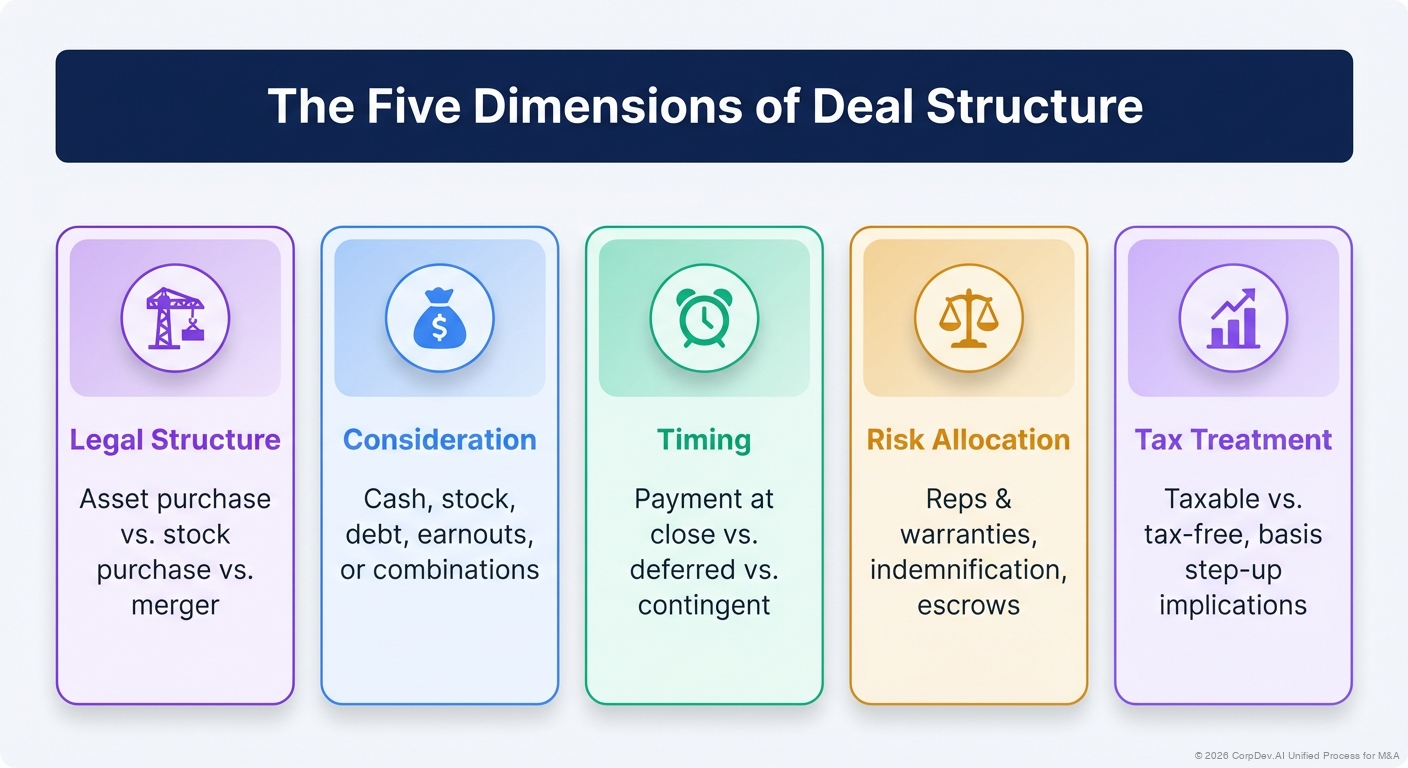
Every structure comes down to five decisions. The table shows the choices for each and what you trade off.
| Decision | Choices to evaluate | What you trade off |
|---|---|---|
| Legal form | Shares, assets, merger, minority stake, joint venture, or another structure | Control, what needs consent to transfer, which liabilities come along, and whether the deal can be completed |
| Payment | Cash, buyer shares, seller rollover, deferred amount, contingent amount | Certainty, liquidity, dilution, alignment, and risk sharing |
| Price mechanics | Agreed equity price, completion accounts, locked box, specific adjustments | The date the economics pass to the buyer, and protection against value leaking out |
| Risk allocation | Conditions, representations, indemnities, escrows, insurance, covenants | Who bears a bad outcome, and whether the money can actually be recovered |
| Funding and closing | Available cash, debt, new equity, staged completion | Certainty of funds, lender constraints, dilution, and time to ownership |
The decisions interact, so settle them together. An asset purchase may improve some tax results but make key contracts harder to transfer. A share purchase may keep contracts and permits in place, but the company arrives with its past liabilities. Counsel and tax advisers must assess the actual facts.
Map what needs consent under a share deal and an asset deal
Whether contracts transfer easily can decide between a share deal and an asset deal. In a share purchase, contracts generally stay with the company, but change-of-control clauses can let the other party terminate or renegotiate. In an asset purchase, contracts generally must be assigned or signed again, often with consent. Permits and licenses follow their own rules.
Build a consent matrix from the contracts and amendments, with a clause reference for each entry. Counsel should confirm the interpretation and identify which consents affect the structure, timing, or ability to transfer the business.
A hypothetical example:
| Document | If we buy shares | If we buy assets | What depends on it | Question for counsel |
|---|---|---|---|---|
| Supply agreement, largest customer | Customer may terminate on 60 days' notice after a change of control (§14.2) | Assignment needs written consent (§18.1) | 22% of revenue | Does asking for consent under either structure invite a price discussion? |
| Operating permit, main plant | Silent; permit stays with the company | Issued to the company; transfer process unclear | All production | Would an asset deal need a new permit, and how long would it take? |
| ERP software license | No change-of-control clause | Cannot be assigned (§9) | Order-to-cash | Re-sign or replace, and at what cost? |
The map feeds three decisions. It shows whether consents favor one legal form, to weigh against the tax comparison. It names the contracts and revenue for the risk-allocation table below. And it lists the consents the closing conditions must track.
The check that matters: counsel reviews every row with revenue or operations attached, including rows marked silent. A contract that says nothing about assignment is not always free to transfer; the governing law can still restrict it.
Agree what “a $200 million deal” means
Negotiate from a written bridge. “A $200 million deal” means little until both sides agree whether it refers to enterprise value, equity value, cash paid at closing, or the maximum including contingent payments.
The hypothetical bridge below shows how $200 million of enterprise value becomes $150 million of cash at closing.
Illustrative bridge, in millions:
Agreed enterprise value                           200
Add: cash in the target at closing                   8
Less: debt and agreed debt-like items               35
Add: working capital adjustment                      2
Equity value paid for the shares                   175
Less: escrow held back at closing                   10
Less: fixed deferred payment                        15
Cash paid to sellers at closing                    150
The example leaves out fees, taxes, rollover, and contingent payments. An escrow holds back part of the proceeds; it does not automatically reduce the agreed value. Write a definition for every line of the bridge, plus transaction expenses and leakage, so that no item counts twice.
Test the price adjustment on real months
There are two common ways to fix the final price. Completion accounts adjust the price using balances measured at closing. A locked box sets the price from an agreed historical balance sheet, with negotiated protection against value leaving the business after that date. Either label leaves the details open.
For whichever mechanism you use, agree:
- Which accounting rules apply, and in what order of priority
- The definitions, the reference period, and how seasonality is treated
- Who prepares the numbers, and what access the other side gets to review them
- How disputes are resolved, and when payment is made
Run the formula on several historical months and on a hypothetical closing balance sheet before signing.
The working capital target, or peg, deserves the most care. A peg set from an unusual month can hand value to the other side without anyone noticing. Before accepting one, look for unusual collections or delayed supplier payments, inventory swings, customer advances, and carve-out allocations. Ask finance to bridge the reported balances to the contract definitions.
Pick each form of payment for a reason
Each form of payment solves one problem and creates others. Match the form to the problem you need solved.
| Form of payment | What it does | What you must settle |
|---|---|---|
| Cash | Gives a clear nominal value | The buyer carries the financing risk and most of the performance risk after closing |
| Buyer shares | Pays without cash; the seller shares in the combined outcome | Exchange ratio, valuation, governance, liquidity, and dilution. Compare outcomes at several buyer share prices; shares are not free financing |
| Rollover | Keeps the seller invested in the combined business | Alignment depends on governance, exit rights, economic preferences, information rights, and the risk the seller actually keeps |
| Fixed deferred payment | Changes when you pay, and adds counterparty risk | Whether it is secured, subordinated, subject to set-off, or conditional |
| Earnout | Shares one uncertain outcome | Works only when the outcome can be measured and the operating setup supports it; adds administration and dispute risk. See earnouts and contingent consideration |
Put a number on every risk you negotiate
Keep a risk-allocation table that ties each finding to money. A list of clauses cut off from the investment case hides what is really being traded. The rows below are examples.
| Finding | Economic exposure | Proposed response | Risk that remains |
|---|---|---|---|
| A major customer may not consent | Lost revenue and stranded cost | Consent condition, repricing, or a different perimeter | How the customer behaves after consenting |
| Transition services may end before migration is done | Service interruption and emergency replacement cost | Defined TSA scope, extension rights, and a funded exit plan | Buyer's ability to carry out the plan |
| A tax position is unresolved | A range of cash tax, interest, and process cost | Specialist analysis and a negotiated allocation | Limits, exclusions, and whether the seller can pay |
| A key product depends on third-party rights | Lost functionality or replacement investment | Confirmation of rights, or a condition to closing | The continuing dependency |
A protection is only as strong as its wording, whether it can be enforced, whether you can actually collect, and how closely it fits the risk. Counsel judges whether it works legally. Finance models the exposure that remains.
Write the negotiating mandate on total economics
The internal mandate states four things: the target outcome, the authorized range, when to escalate, and when to walk away. Cover the whole package, not just price. Capital commitments, integration costs, remedies, contingent payments, and financing costs can each change whether the deal is worth doing.
Record every package trade. If you accept a higher price in exchange for stronger protections, keep both halves of that bargain in every later draft. Otherwise the same concession gets given away twice, once in the legal conversation and again in the business or financial one.
Plan signing and closing as separate events
Signing commits both parties to the agreement. Closing transfers ownership on the agreement's terms. In between, every condition has to be met. Track the conditions in a matrix like the one below, which shows one hypothetical row.
| Condition | Owner | Evidence it is met | Deadline | Depends on | Who can waive | Status |
|---|---|---|---|---|---|---|
| Largest customer consents to the change of control | Commercial lead | Signed consent letter | Two weeks before the outside date | Customer's legal review | Buyer's CEO | Requested |
Include financing, approvals, consents, separation, and operational readiness where they apply.
Prepare the funds flow and approvals with treasury, legal, and finance. Reconcile every amount to the latest contract definitions and the closing statement. If something material changes after approval, take it back to whoever approved the deal. Never absorb it quietly into the closing mechanics.
Give the committee a complete structure pack
Before binding approval, the committee should receive:
- A perimeter map
- The bridge from enterprise value to equity value
- Sources and uses of funds
- A tax comparison of the structures considered
- A summary of how risks are allocated
- The key negotiated terms
- The closing conditions
- The integration dependencies
State which terms are still open, and which changes would require a new approval.
After signing, hand the obligations register to the people who will run it. Deferred payments, reporting rights, price adjustments, retention arrangements, and transition services need owners long after the negotiators have moved on.
Continue with tax considerations, negotiation strategy, and divestitures and carve-outs.
© 2026 CorpDev.Ai Unified Process for M&A