
Precedent Transaction Analysis
Precedent transactions show what specific buyers paid for specific businesses under specific conditions. They help a deal team understand how buyers price assets, what the seller will expect, and what rival bidders might pay. They do not prove that the same multiple fits today, or that the earlier buyer earned a good return.
The value lies in rebuilding the economics and context behind each deal. A database export with a median is only a starting point.
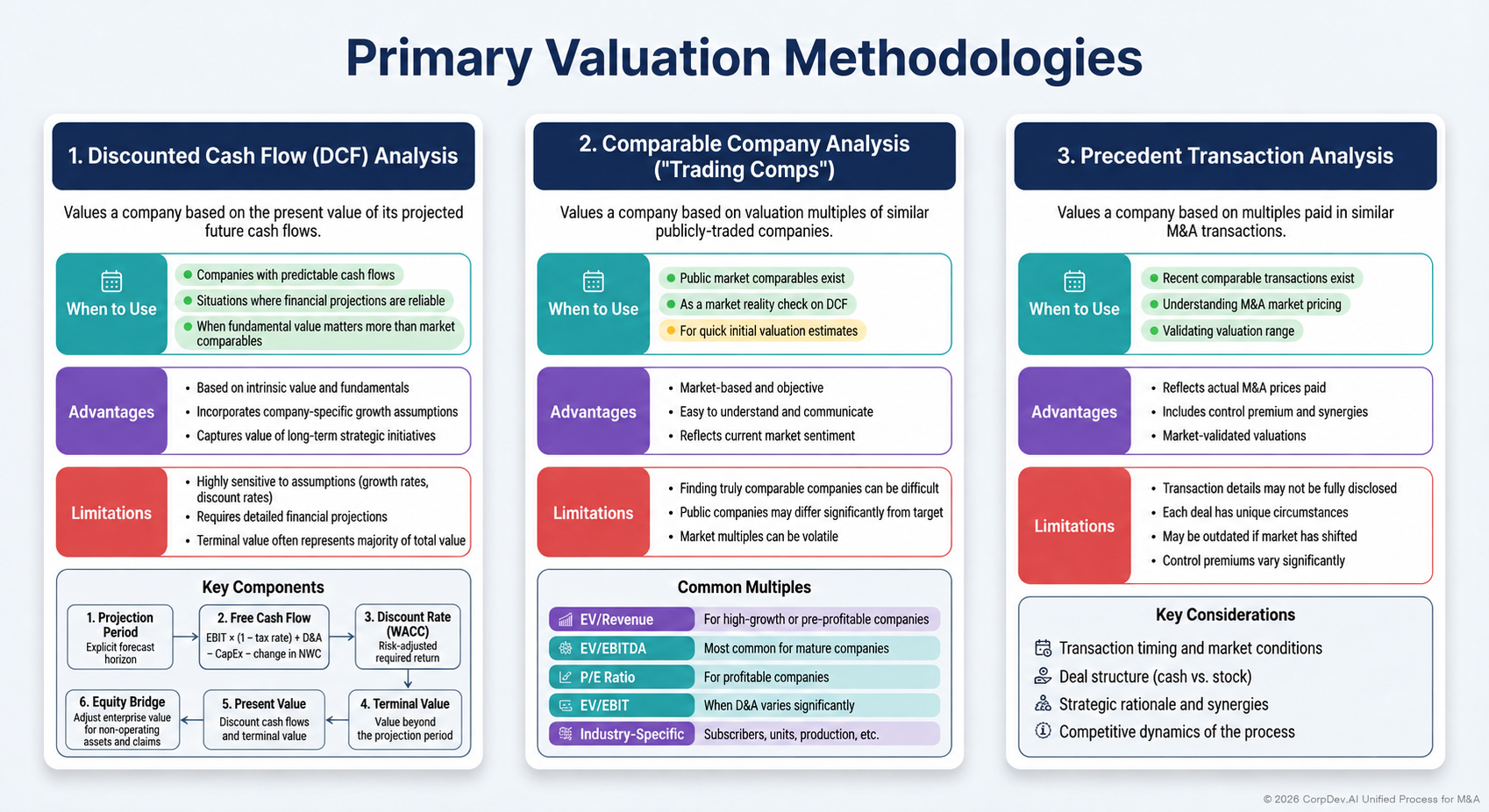 Discounted cash flow ↗Discounted cash flow: when to use ↗Discounted cash flow: strengths ↗Discounted cash flow: limitations ↗Comparable company analysis ↗Comparable company analysis: when to use ↗Comparable company analysis: strengths ↗Comparable company analysis: limitations ↗Precedent transactions ↗Precedent transactions: when to use ↗Precedent transactions: strengths ↗Precedent transactions: limitations ↗DCF projection period ↗DCF free cash flow ↗DCF discount rate ↗DCF equity bridge ↗DCF present value ↗DCF terminal value ↗EV / revenue ↗EV / EBITDA ↗Price / earnings ↗EV / EBIT ↗Industry-specific multiples ↗Transaction timing and market conditions ↗Deal structure ↗Strategic rationale and synergies ↗Competitive dynamics of the process ↗
Text links for this illustration
- Discounted cash flow
- Discounted cash flow: when to use
- Discounted cash flow: strengths
- Discounted cash flow: limitations
- Comparable company analysis
- Comparable company analysis: when to use
- Comparable company analysis: strengths
- Comparable company analysis: limitations
- Precedent transactions
- Precedent transactions: when to use
- Precedent transactions: strengths
- Precedent transactions: limitations
- DCF projection period
- DCF free cash flow
- DCF discount rate
- DCF equity bridge
- DCF present value
- DCF terminal value
- EV / revenue
- EV / EBITDA
- Price / earnings
- EV / EBIT
- Industry-specific multiples
- Transaction timing and market conditions
- Deal structure
- Strategic rationale and synergies
- Competitive dynamics of the process
Decide what question the precedents must answer
State the purpose first: to understand the seller's expectations, frame an opening offer, assess an auction, or cross-check a valuation you have already built. The right sample depends on the purpose.
Describe the target before you search: business model, size, growth, geography, customer mix, capital intensity, and profitability. Write down the selection rules and which differences you will tolerate. Keep a broader context set separate from the deals that support the main range.
Confirm each deal happened as described
Confirm the facts from primary disclosures where they exist: buyer, seller, what was bought, announcement date, completion status, stake acquired, and consideration. Separate announced deals, completed deals, minority investments, asset purchases, and terminated transactions.
An abandoned deal can reveal a regulatory or financing constraint, but its announced price is not evidence of a completed exchange. Never mix it silently with completed deals. For US public companies, use the relevant filings on SEC EDGAR and the parties' announcements.
Do not turn estimated database figures into facts. If the price or the earnings figure is undisclosed, show it as unavailable. Inventing a revenue estimate to produce a multiple adds precision without evidence.
Rebuild what the buyer actually paid
A headline "transaction value" may mean equity consideration, enterprise value, maximum consideration, or a figure that includes assumed obligations. Read the definition and build a bridge. The table lists what to resolve for each deal.
| Component | Question to resolve |
|---|---|
| Cash consideration | Amount paid for shares or assets; timing and adjustments |
| Buyer shares | Exchange ratio and the date used to value the shares |
| Debt and other claims | Assumed, refinanced, or excluded; treatment in the headline value |
| Cash acquired | Included, excluded, or restricted |
| Contingent consideration (earnouts) | Maximum, expected, fair-value estimate, or excluded |
| Rollover and retained interest | Percentage acquired and rights the seller keeps |
| Fees and transaction costs | Included in the reported value or outside it |
| Perimeter | Whole company, selected assets, or a business that depends on transition services |
Apply one convention across the sample. If the disclosure does not support a reliable bridge, drop the deal from the core multiple analysis or show it separately as lower-confidence context.
Worked example: rebuilding one deal
Fictional transaction, in millions: The announcement states $300 million of equity consideration, $50 million of debt assumed, and $20 million of cash acquired. It also mentions an earnout of up to $40 million that is not included in the stated equity consideration.
Enterprise value excluding earnout = 300 + 50 − 20 = 330
Maximum enterprise value including earnout = 330 + 40 = 370
If disclosed LTM EBITDA is $30 million, the multiples are 11.0× and 12.3×. Neither is an expected-value multiple unless there is evidence about the earnout. A probability the analyst invents does not become disclosed consideration.
If the target you are valuing has normalized EBITDA of $20 million, an analytically supported range of 10–12× implies $200–240 million of enterprise value. This illustrates the arithmetic; it is not a current market range or a recommendation.
Build an evidence pack behind every precedent
The worked example needed one announcement. A real sample has a dozen deals, and the terms that change a multiple sit in different documents. The press release gives the headline. The agreement defines the price. The closing announcement confirms what completed. The buyer's next annual report may show the fair value it recorded for an earnout. Databases mostly carry the headline, so a sample can quietly mix upfront prices, maximum earnouts, and partial stakes.
Build the same price bridge for each transaction, with a source passage behind every number. Distinguish announced terms from completed terms and record unresolved definitions.
A hypothetical example:
| Deal | Headline value | What the documents show | Rebuilt enterprise value | Core sample? |
|---|---|---|---|---|
| A | $370m | $300m equity, $50m debt assumed, $20m cash acquired; the headline adds the $40m maximum earnout | $330m upfront; $370m at maximum earnout | Yes, with the earnout shown separately |
| B | $480m | The buyer bought 60% of the shares; the headline is the price for that stake; net debt not disclosed | Not disclosed | No; context only |
| C | $250m | Agreement terminated before closing after regulatory review | Not applicable | No; evidence of a regulatory constraint |
Move every deal with an undisclosed value or earnings figure out of the core multiple analysis, and keep it as context. Then rebuild the multiples in the workbook from the quoted figures. The one check that matters: a second person opens the quoted sentence behind every figure that changes a multiple, especially debt treatment, stake size, currency, and earnouts.
Use the financials known at the time of the deal
Divide enterprise value by a pre-financing earnings measure, with a consistent period and definition. LTM results at announcement, the prior fiscal year, and management's forward forecast are three different denominators.
Record the financial period, publication date, accounting basis, adjustments, and whether the figure includes businesses acquired later. Never use the target's later, better results to make the original multiple look lower.
If a published multiple includes expected synergies, label it. A multiple of post-synergy EBITDA does not compare with a target's standalone EBITDA multiple.
Record the source and confidence of each figure
For each precedent, keep the disclosure link, page or section, exact metric definition, rebuilt value, and open questions. Make the confidence note specific. "Enterprise value disclosed; revenue reported; EBITDA unavailable" says more than a high, medium, or low label.
Have a second person reproduce a sample of the calculations. Errors often come from debt treatment, currencies, minority stakes, and contingent payments rather than arithmetic.
Explain why prices differ
Look for the reasons one buyer paid more than another:
- Strategic fit and overlapping operations
- The competitive process and financing
- Seller constraints and control rights
- Business quality and market conditions
Keep what is disclosed separate from what you infer.
A strategic buyer may capture benefits no other buyer can. A private equity firm may already own a platform business that creates large synergies. Never assume every corporate buyer pays more than every financial sponsor, and never add a fixed premium because a deal was an auction.
Likewise, paying in cash or in shares does not justify a standard adjustment. Value and risk depend on the terms, the measurement date, and the ownership economics.
Adjust for time and market changes with care
Show announcement dates and the market conditions at the time. Older deals can still explain how buyers behave, but their prices are not interchangeable with today's.
A sector index gives context on market movement. Scaling an old multiple by the change in an index assumes a relationship that may not hold for the business that was sold. If you use that adjustment as a scenario, label the assumption and keep the unadjusted figure beside it.
Count control and synergies only once
A completed control transaction already reflects the agreed price for control. Adding a generic control premium on top of the precedent multiple can count the same effect twice.
Disclosed synergy estimates do not necessarily show how much was paid to the seller or how much value the buyer realized. Never subtract management's synergy headline from the price and call the remainder proven standalone value. Rebuild the timing, costs, taxes, and risk if the disclosures allow it; if not, state the limitation.
Show the committee a decision, not a median
The committee page should show:
- The core sample, the observed range, and the selected range
- Why deals were included or excluded
- The consideration convention and the financial period
- Data limitations
Put individual deal profiles and sources in an appendix.
Explain how the precedents relate to the buyer's DCF, integration economics, and other uses of the capital. If the market seems to demand more than the buyer can justify, the right response may be to walk away. Never reshape the sample until it supports the bid.
Keep a reusable record for each precedent
Capture these fields for every deal:
- Transaction identifier, parties, and perimeter
- Percentage acquired, announcement and completion dates, and status
- Primary sources and currency
- Consideration bridge
- Financial period, reported and normalized metrics, and implied multiples
- Disclosed rationale and comparability assessment
- Confidence limitations, reviewer, and last verification date
Continue with trading comparables, valuation methods, and negotiation strategy.
© 2026 CorpDev.Ai Unified Process for M&A