
M&A Process Overview
The M&A process takes an idea for an acquisition through a signed deal to a business that delivers what was promised. The stages give leadership clear points to decide, but the work overlaps. Diligence changes the valuation, integration plans change the price, and financing or antitrust needs can shape the deal before any offer exists.
Run the process around commitments. At each stage, ask what the company is being asked to commit, what the team has learned, what is still uncertain, and who can approve the next step. The process is working when leadership can see why the next commitment is justified, and when stopping a deal is still a legitimate outcome.
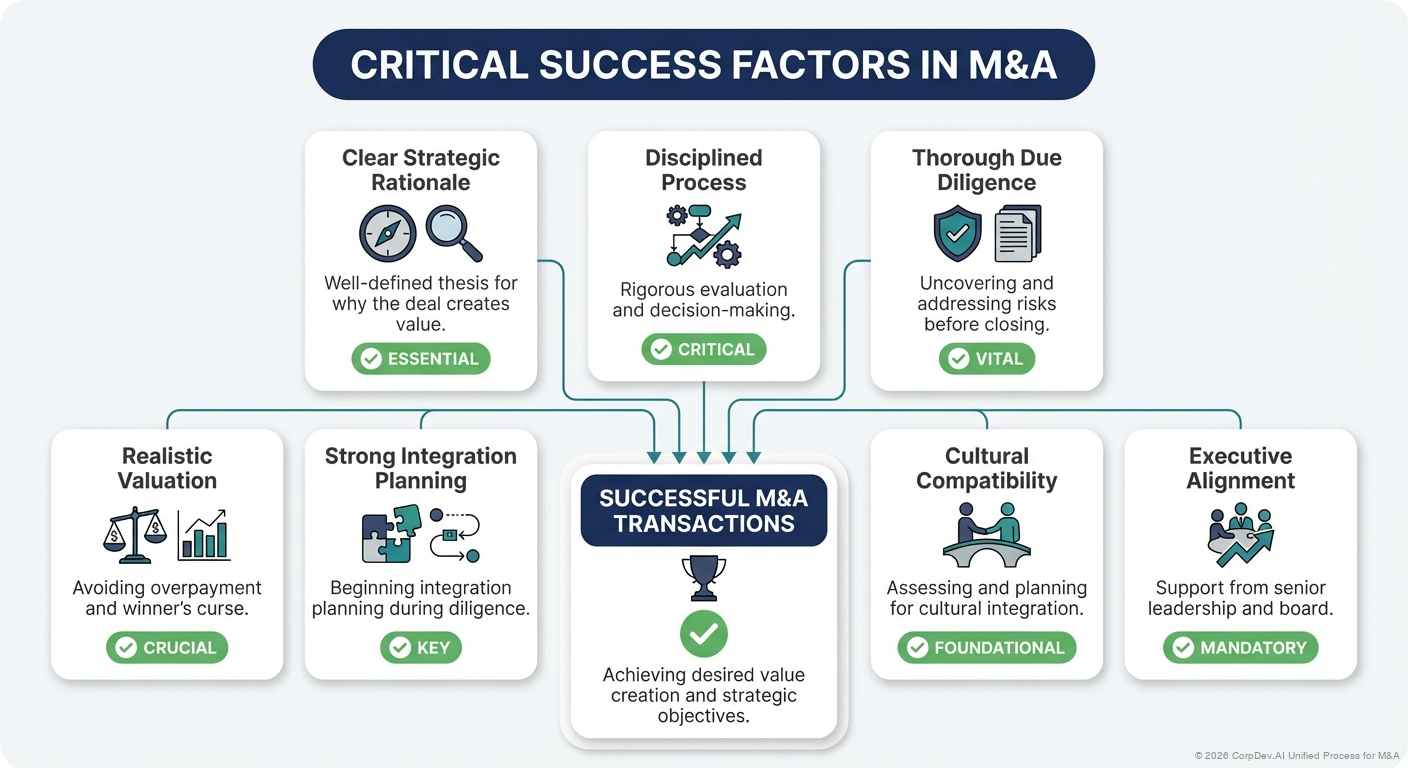 Clear strategic rationale ↗Disciplined process ↗Thorough due diligence ↗Realistic valuation ↗Strong integration planning ↗Cultural compatibility ↗Executive alignment ↗Value creation and strategic outcomes ↗
See the whole lifecycle on one page
Each stage exists to make one decision. The table shows that decision, the evidence behind it, and who usually coordinates the work.
| Stage | Decision | Evidence or output | Who coordinates |
|---|---|---|---|
| Strategy | Which kinds of companies should we buy, and why? | Approved theses and the alternatives to buying | Strategy and CorpDev |
| Sourcing | Which companies deserve attention? | Market map, relationships, and a first view of fit | CorpDev |
| Initial evaluation | Is this deal worth pursuing? | A business sponsor, a preliminary case, and the key unknowns | Deal lead |
| Offer or LOI | What can we propose? | Approved price basis, what the deal includes, and conditions | Deal lead with finance and counsel |
| Diligence and structuring | Does the case hold, and how do we handle the risks? | Findings tied to the model, the terms, and the operating plan | Deal lead and workstream owners |
| Signing | Should we sign the definitive agreement? | Final recommendation and approved documents | The approving body |
| Signing to closing | Are the conditions, funding, and operations ready? | Closing checklist and readiness evidence | Counsel, treasury, and integration lead |
| Integration | How will the combined business deliver the promised result? | Funded plan and a named owner for each benefit | Business owner and integration lead |
| Post-close review | What happened, and what should we change? | Bridge from the approved case to actual results, with lessons | Finance, business owner, and CorpDev |
These roles are illustrative. Apply your company's actual delegation of authority and the needs of each deal.
Keep one record of the deal from day one
At launch, create one record that the whole team works from. It holds:
- The thesis and the proposed perimeter: the entities, assets, and operations the deal would include
- The business sponsor and the deal lead
- The approval history and the current model version
- Critical issues and the next decision
Link to the evidence instead of copying conclusions into separate presentations.
Set confidentiality and access rules with counsel before the team grows. Confirm what the target allows you to share inside the company and with advisers. Take particular care when the target is a competitor: the FTC describes safeguards for sensitive information during diligence and integration planning. FTC guidance.
Start a decision log and an issue register at the same time. Record who owns each important question and what was decided, so the work does not restart at every approval.
Screen before spending serious time or money
Initial evaluation should confirm five things before the company commits real resources:
- The target fits an approved thesis.
- There is a credible reason it is worth more to you than to other owners.
- A business leader wants to sponsor it.
- The economics could plausibly work.
- Nothing already known makes further work pointless.
Name the most important unknowns. With limited information, a preliminary model should show ranges instead of false precision, and say which evidence could move them. End with one of three decisions: pursue, pause until specific evidence arrives, or stop. An open question is never permission to carry on by default.
Make the offer set up a process you can run
An indication of interest or letter of intent (LOI) should state a commercial position that leadership has approved. It defines the business being bought, how the price is built, the key assumptions, the proposed structure, diligence access, and process requirements. Ask counsel to confirm the legal effect of each provision; the document's title does not settle it.
Before asking for exclusivity, confirm you can staff and fund the work in the period requested. Name what each side must deliver. If you cannot support the price without information you have not yet seen, say so in the offer. Do not promise a firm price you already plan to revisit.
See letters of intent and term sheets.
Run diligence, valuation, and integration planning together
Start diligence with the assumptions that decide value and feasibility. Each workstream lead names the evidence that would confirm or disprove them. Every finding then lands in one of five places: the forecast, a contract term, a funded action, a risk someone with authority accepts, or a decision to stop.
Connect the workstreams on purpose. Customer concentration affects both commercial risk and the forecast. Technology fixes affect integration cost and how soon value arrives. Working-capital mechanics change what you actually pay at closing. A good status report shows these links; a page of red, amber, and green boxes hides them.
Bring the integration leader in while the company can still change the terms or walk away. A plan written after signing cannot inform a decision already made.
Approve the deal you will actually sign
The final recommendation should reconcile today's proposal with every earlier approval. Show:
- Changes in price and structure
- New findings and what is still uncertain
- Downside exposure and funding
- The operating commitments the business must make
Separate legal protection from getting your money back. A contractual remedy may not make up for a disrupted business or a lost customer. Explain the exposure that remains and who accepts it. Record dissent and any conditions attached to the approval precisely.
If negotiations change the approved case significantly, follow the company's re-approval rules. A document ready for signature does not mean the business decision has been made.
Run signing and closing as separate controls
Signing commits both sides to the deal. Closing is when ownership changes hands, once the conditions are met. Three owners run the period in between:
| Area | Owner | What they confirm |
|---|---|---|
| Closing conditions | Counsel, with the specialists affected | Approvals, consents, and other conditions are satisfied |
| Funding | Treasury | Financing is ready and the flow of funds is controlled |
| Operating readiness | Integration leader, with functional owners | Each function can run the business on Day 1 |
Manage the critical path through the real dependencies: approvals, financing conditions, consents, separation work, systems readiness, and contract dates. Never promise a standard deal length. A timetable is a plan with assumptions and contingencies, not a benchmark that fits every deal.
Confirmation of closing should come from the owners authorized to give it. Legal completion, the movement of funds, operating readiness, and public announcements must be coordinated, but they are separate events.
Review the combined deal calendar
Bring the transaction, funding, specialist review, and integration calendars together. Check dependencies and identify where the same people are committed to overlapping work. Each deadline needs an owner and an escalation route. When one date moves, update the affected plans and approvals before the team relies on the old sequence.
Hand the deal to the people who will run it
At closing, give named operating owners:
- The approved baseline and the value initiatives
- The risks the company kept and the contract deadlines
- The integration budget and the reporting definitions
Confirm that each owner accepts, and keep access to the underlying evidence.
Watch the buyer's existing business as well as the acquired one. Integration draws on leaders, customer attention, and systems capacity across the company. Track those costs and lost benefits next to the gains.
A post-close review should separate four causes of any gap: a mistake in the original case, execution, changes in the outside world, and deliberate changes in strategy. Keep the original case visible so the next deal learns from what actually happened.
Use one memo format for every approval
Use the same structure for every major approval, so reviewers always know where to look:
- The commitment requested
- The recommendation
- The evidence for it
- What changed since the last approval
- The alternatives
- The open issues that matter
- The downside
- The resources required
- The conditions
- The named owners
Attach the model and the specialists' conclusions. Put the decision up front instead of burying it in a long presentation.
Continue with target identification and sourcing, due diligence, and approval gates.
© 2026 CorpDev.Ai Unified Process for M&A