
Strategic Framework for M&A
A useful M&A strategy tells the company what to pursue, what to decline, how much it can commit, and what it must be able to operate after closing. It should reduce the number of superficially attractive deals that consume executive attention. A set of market maps and acquisition themes is not enough unless it changes capital allocation and operating choices.
For a significant company, CorpDev's role is to translate corporate and business-unit priorities into an investable set of choices. The output is a small number of acquisition mandates with accountable sponsors, comparable alternatives, evidence requirements, and price discipline.
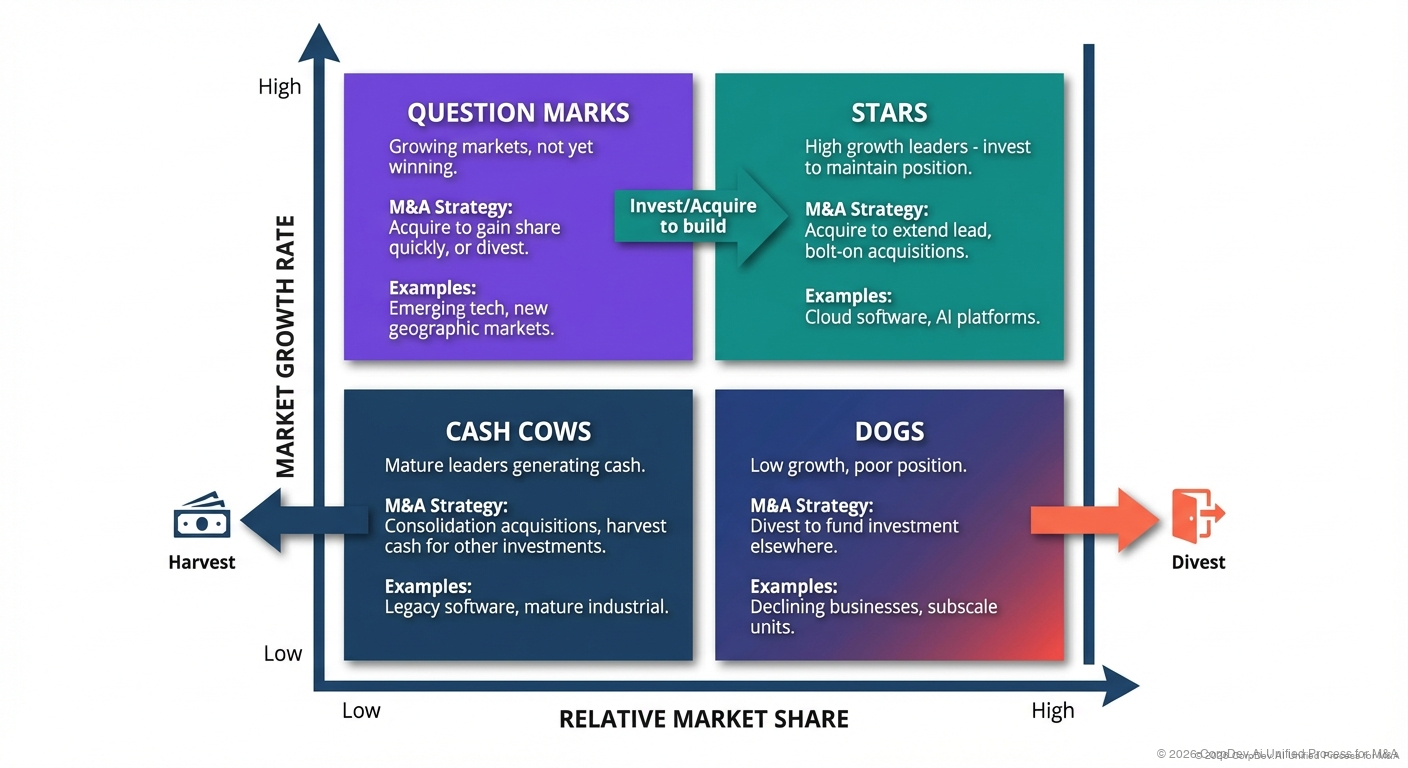 Stars: extend advantage through capability acquisition ↗Question marks: compare build, buy, partner, and wait ↗Cash cows: manage the portfolio of commitments ↗Dogs: evaluate divestitures and retained-business economics ↗Divest or exit ↗
Start with the business outcome
Begin with an outcome the business needs: serve a new customer workflow, close a product gap, enter a geography, secure a scarce capability, improve service coverage, or reshape a portfolio. Specify the customer, economic mechanism, timing, and operating owner. “Participate in AI” or “become a platform” does not identify a decision.
Work backward to the capability gap. List what the company already has, what it can realistically develop, what can be accessed through a partner, and what requires ownership. Distinguish essential capabilities from attractive additions. The target universe should follow this logic rather than define it after a banker introduces a company.
An acquisition mandate can fit on one page:
| Field | Required content |
|---|---|
| Business outcome | Customer or operating result and the date by which it matters |
| Capability gap | Specific technology, people, assets, rights, or distribution required |
| Why ownership? | Benefits of control that a partnership or commercial contract cannot deliver sufficiently |
| Target boundary | Relevant products, customers, geographies, size, and exclusions |
| Value mechanism | Incremental cash flows and the dependencies required to earn them |
| Resource envelope | Capital, leadership attention, specialist capacity, and integration budget |
| Sponsor | Executive who accepts the operating commitment |
| Evidence and stop rule | Facts needed to proceed and findings that terminate the mandate |
Compare build, buy, partner, and wait fairly
Use a common customer outcome and time horizon. Compare the investment needed, time to usable capability, probability of delivering it, operating economics, strategic control, reversibility, and subsequent obligations. Buying a fully commercial business should not be compared with building only its technology prototype.
The build case includes recruiting, development, failed iterations, launch, customer acquisition, support, and opportunity cost. The buy case includes purchase consideration, integration, retention, migration, stand-alone investment, and transaction risk. The partner case includes commercial economics, integration, governance, dependency, and termination or change-of-control exposure. Waiting has a cost only where supported by a credible counterfactual; it also preserves capital and information value.
Have different functions challenge the alternatives. Product and engineering should review build feasibility; procurement or alliances should review partner options; finance should normalize cash flows; the business sponsor should assess delivery and customer relevance. CorpDev should not own the acquisition case and quietly assume the alternatives fail.
Separate target quality from buyer advantage
A high-quality target may be a poor acquisition for this buyer. Assess the target's standalone durability separately from the buyer's ability to improve it. Then document the buyer-specific advantage: customer access, shared infrastructure, manufacturing capability, geographic presence, or complementary intellectual property.
Every claimed advantage needs a mechanism and owner. Cross-sell requires an eligible account base and selling motion. Faster development requires compatible architecture and people available to do the work. Procurement savings require overlapping spend and feasible specifications. A public-company valuation multiple is not itself an operating advantage.
Use scorecards to organize evidence, not automate approval. A target should not offset an unresolved existential problem by scoring well on unrelated attributes. Mark true gates separately: unacceptable liability, absent critical rights, no operating sponsor, infeasible integration, or a price beyond the approved economic case.
Construct a value bridge the board can challenge
Show standalone value, incremental buyer benefits, implementation costs, dis-synergies, and residual uncertainty separately. Establish the maximum economic price consistent with the company's return and downside requirements. The negotiation target should sit within that ceiling; it should not be reverse-engineered from the seller's aspiration.
Do not count the same improvement twice. If cross-sell is in the cash-flow forecast, it cannot also justify an unexplained platform premium. If the target would achieve a saving independently, only the additional buyer contribution belongs in buyer-specific synergies. If benefits depend on later acquisitions, include the cost and uncertainty of those acquisitions.
Record a thesis sensitivity: the few assumptions that most change value and the evidence needed to resolve them. This directs diligence toward decisions instead of producing a comprehensive but financially disconnected report.
Illustrative build-buy-partner comparison
A fictional industrial company needs remote diagnostics for its installed equipment within two years. Engineering can build the core software, but lacks data connectors, customer deployment experience, and field support. A target has those capabilities; a third-party partner offers a licensed solution.
The original acquisition pitch emphasizes speed. A common-outcome comparison reveals that the target still needs substantial product work to support the buyer's older equipment. The partner can launch a narrower service earlier, while internal development may provide stronger long-term control.
The committee evaluates three fully costed paths. It may still choose acquisition, but only if the acquired team and installed customer evidence justify the purchase and integration cost. A staged partnership can also be rational if it tests customer adoption before committing ownership capital. The decision depends on the actual capability gap, not the label attached to the transaction.
Manage the portfolio of commitments
Evaluate the proposed deal alongside current integrations, capital projects, product launches, and leadership vacancies. Financing capacity does not imply execution capacity. Identify scarce resources by person or function: integration leaders, enterprise architects, regulatory specialists, plant engineers, or business-unit management.
Map correlated exposures across the portfolio. Several acquisitions in different product categories can still depend on the same customer budget, technology provider, commodity, or distribution channel. Stress the combined business, including the cost of supporting a struggling acquisition during a downturn in the core.
Use sequencing deliberately. An enabling acquisition may need to stabilize before bolt-ons can create value. Conversely, a proposed platform with no credible add-on universe or integration method should not receive value for a hypothetical acquisition program.
Operate decision gates that preserve discipline
At mandate approval, confirm strategic need, sponsor, alternatives, and resource envelope. At target approval, establish fit and the evidence needed to justify exclusivity. Before signing, approve the price, downside, commitments, and integration owner. After close, review the original thesis against operating evidence and revise actions when assumptions change.
Keep a decision log that records alternatives rejected, reasons, assumptions, dissent, and approval conditions. This is especially useful when executive sponsors change or an auction becomes competitive. A price exception should identify new evidence or an explicit change in risk appetite, not simply describe the asset as unique.
Review the strategy when evidence changes: customer priorities shift, a build initiative succeeds, a partner becomes available, financing constraints tighten, or integration capacity is consumed. Stop mandates that no longer solve the business problem. A disciplined CorpDev function can demonstrate value through avoided commitments as well as completed transactions.
Use AI to challenge the strategic alternatives
Give the analyst the corporate strategy, business-unit economics, customer evidence, prior investment decisions, and current capacity constraints. Ask it to translate each proposed acquisition theme into a capability gap, value mechanism, operating dependency, and disconfirming evidence. Research the build, buy, partner, minority-investment, and wait alternatives against the same business outcome and time horizon.
The deliverable should be an options memorandum and a source-backed market map that identify where additional evidence could change the choice. Require distinct treatment of established facts, management ambitions, and hypotheses. A numerical ranking can conceal unsupported weights; use the comparison to expose tradeoffs and uncertainty rather than outsource strategic judgment. The business sponsor owns the operating case and finance validates comparable economics. Carry the approved thesis into sourcing questions and investment gates so research remains connected to the decision. See AI strategy and market research.
Related resources
© 2026 CorpDev.Ai Unified Process for M&A